
This note explains how charged particles move in magnetic fields, focusing on transverse magnetic fields and cyclotron motion. It’s part of Physics – Electrodynamics, perfect for university students.
What’s covered?
| Topic | Key Points |
|---|---|
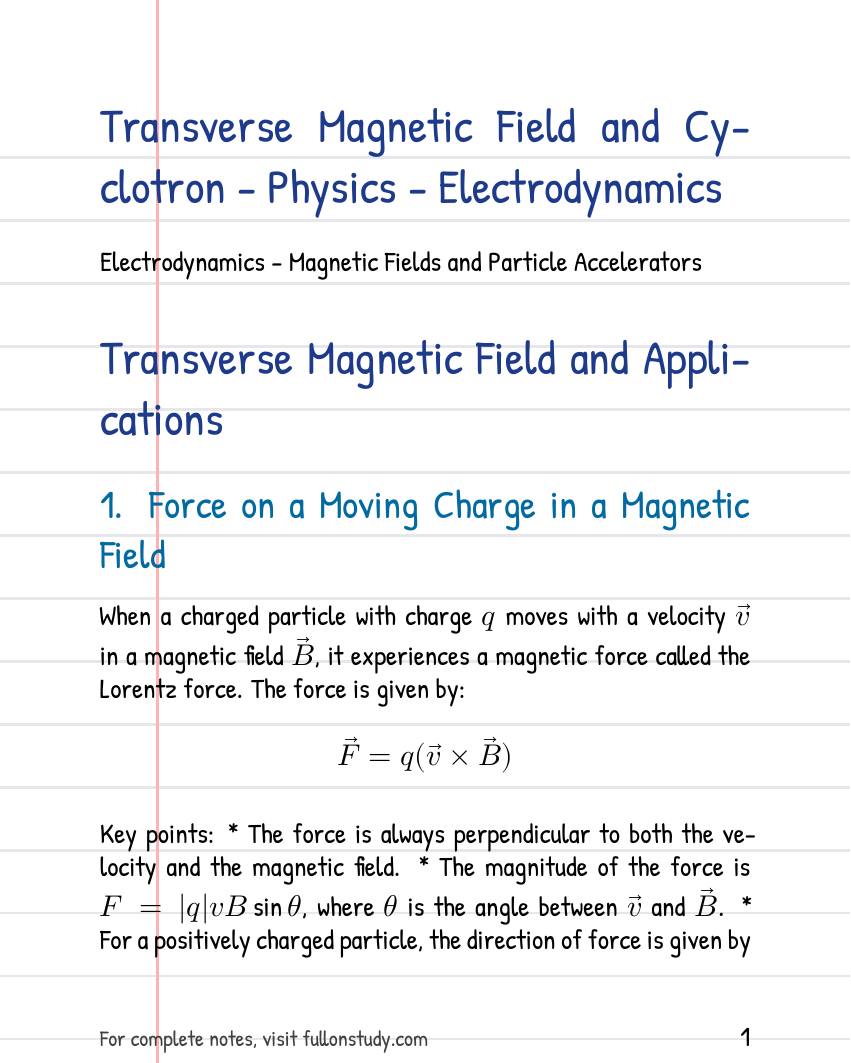
| Force on a Moving Charge in a Magnetic Field | Lorentz force formula, direction using right-hand rule, zero work done by magnetic force |
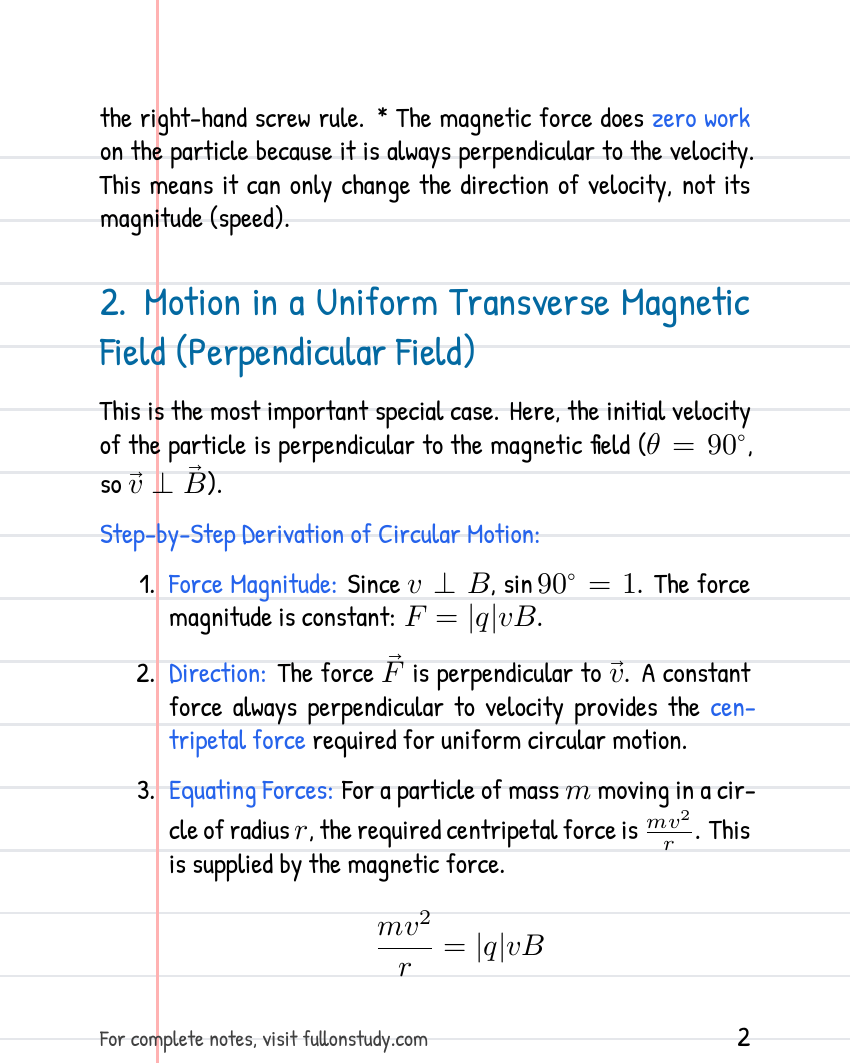
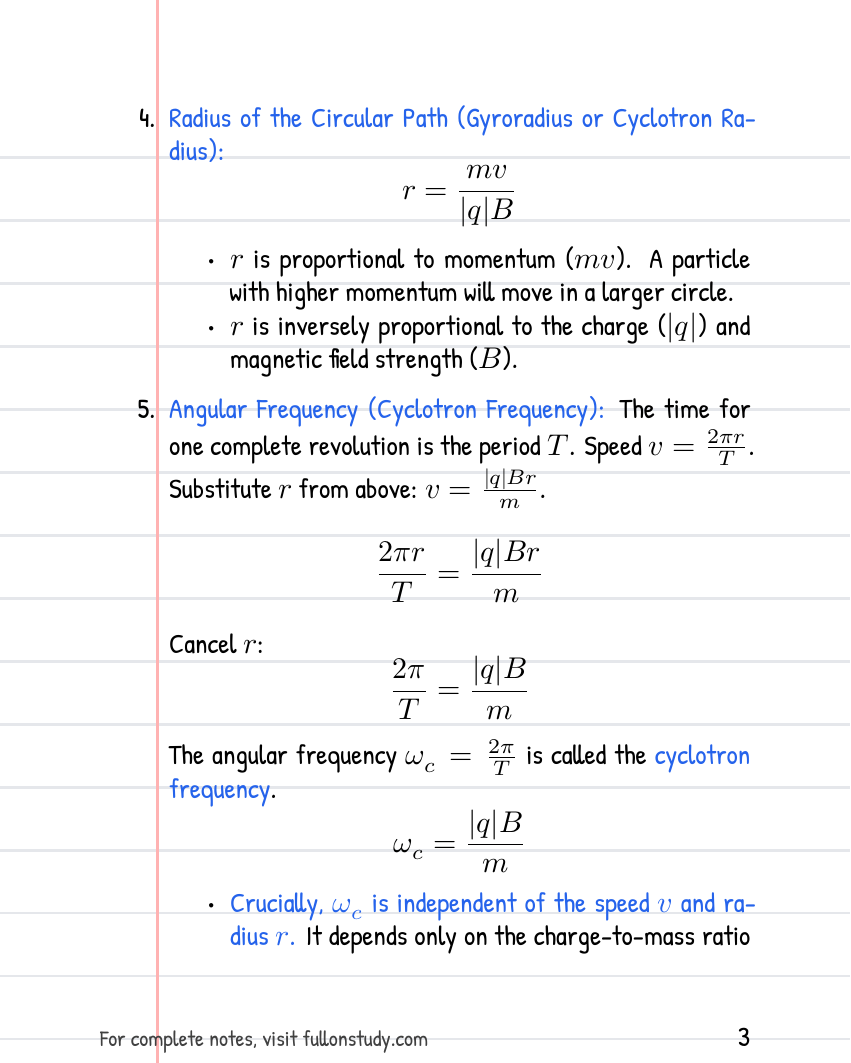
| Motion in a Uniform Transverse Magnetic Field | Derivation of circular motion, cyclotron radius formula, relationship between radius and momentum |
Features
- Easy to understand with step-by-step explanations.
- Covers the complete syllabus for Electrodynamics in Physics.
- Free to download in pdf format for offline study.
- Includes questions and answers at the end of each topic for practice.
FAQs
What is a transverse magnetic field?
A transverse magnetic field is one where the magnetic field is perpendicular to the particle’s velocity. This causes the particle to move in a circular path.
Why does the magnetic force do zero work?
The magnetic force is always perpendicular to the velocity, so it only changes direction, not speed. Since work requires force in the direction of motion, it does zero work.
What is the cyclotron radius formula?
The cyclotron radius is given by r = mv/|q|B, where m is mass, v is speed, q is charge, and B is magnetic field strength. It shows radius increases with momentum and decreases with stronger fields.
- 📄 Format PDF Document
- 🔓 Access Free
- 💾 File Size 0.05 MB
- 📖 Pages 6
- ✅ Reviewed By Manisha Joshi, M.Sc, Physics
- 🗓️ Last Updated April 8, 2026
×
![Preview enlarged]()