
This note explains the motion of charged particles in parallel electric and magnetic fields. It’s a key topic in electromagnetism for physics students.
What’s covered?
| Topic | Description |
|---|---|
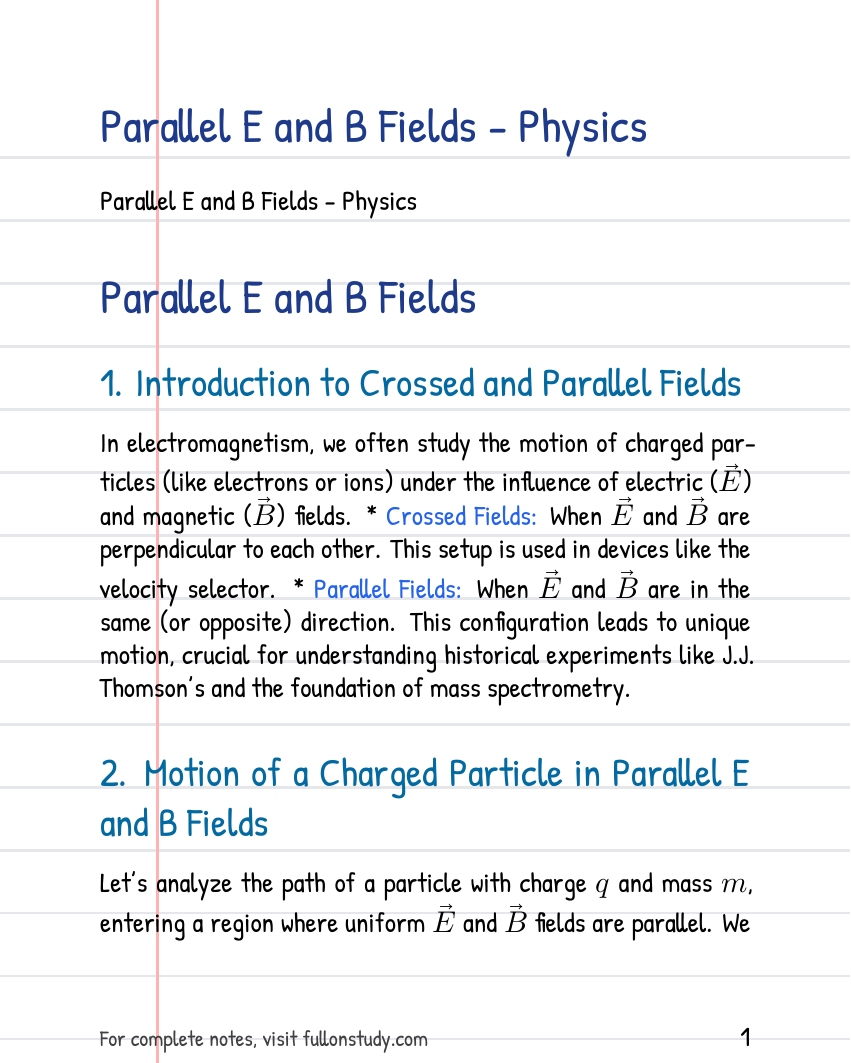
| Introduction to Crossed and Parallel Fields | Explains the difference between crossed fields (perpendicular) and parallel fields (same direction), and their applications in devices like velocity selectors and mass spectrometry. |
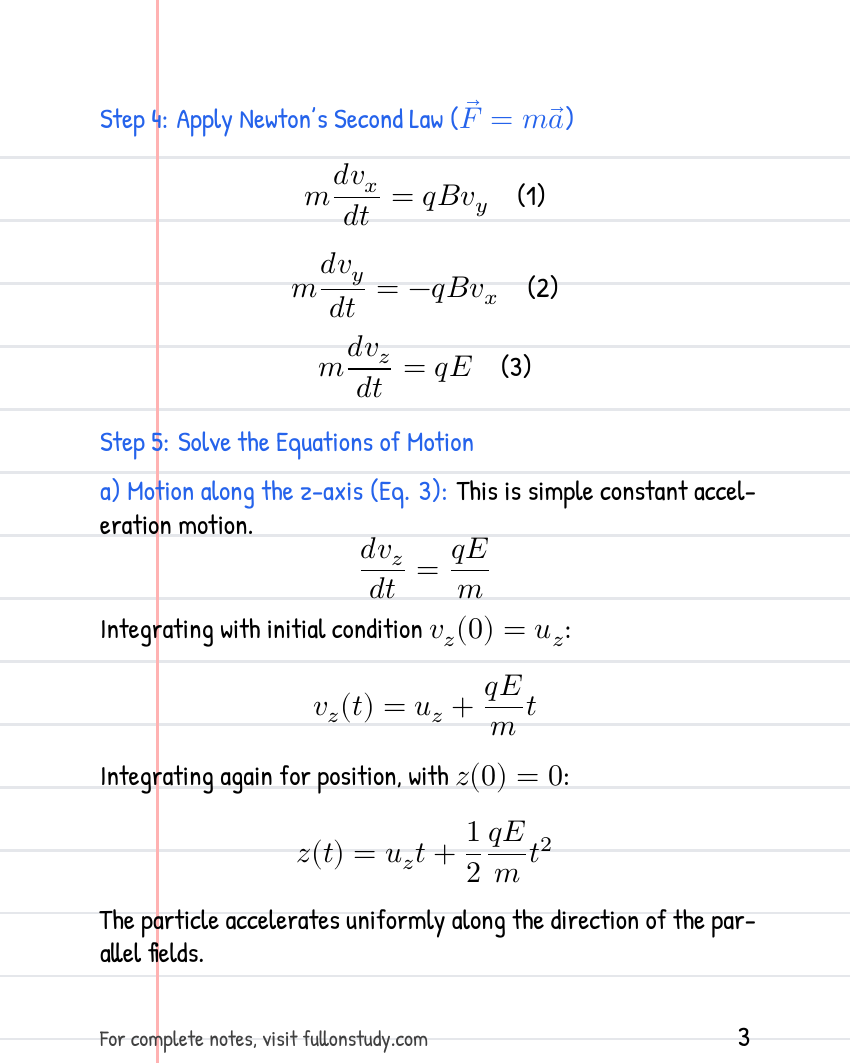
| Motion of a Charged Particle in Parallel E and B Fields | Analyzes the path of a particle with charge q and mass m in uniform parallel fields, using the Lorentz force equation and coordinate system setup. |
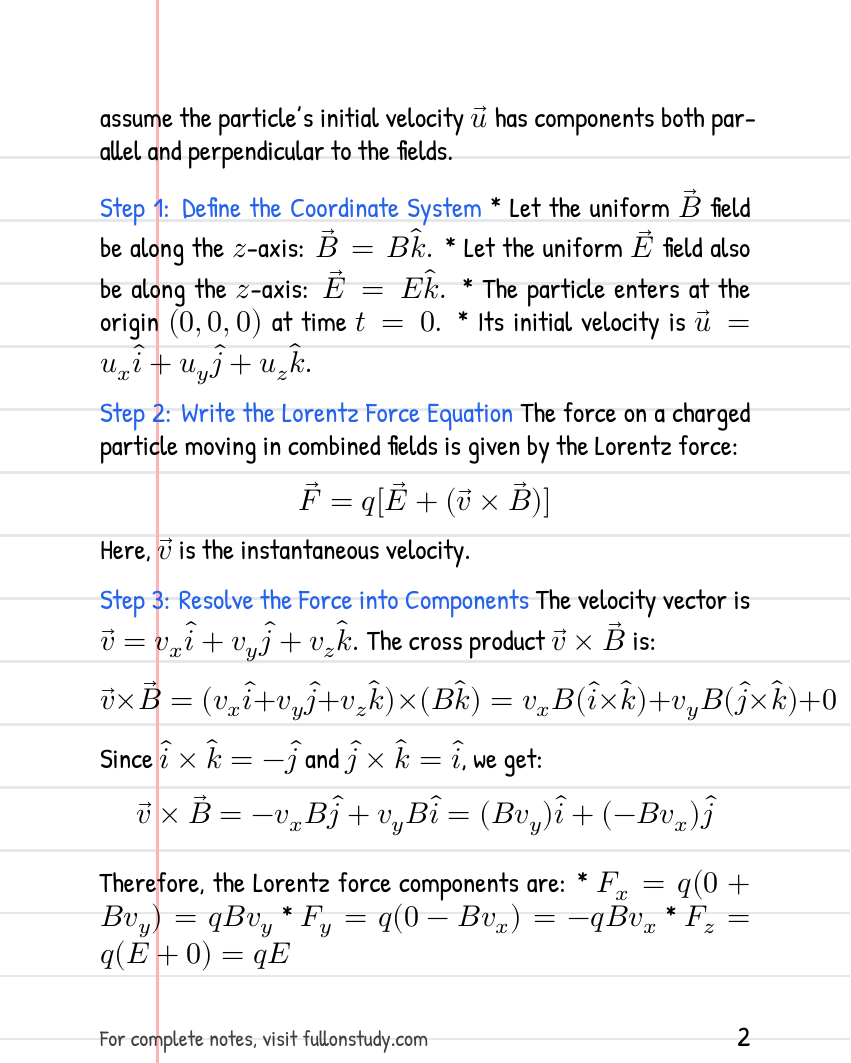
| Coordinate System Definition | Sets up the coordinate system with B and E fields along the z-axis and initial velocity components. |
| Lorentz Force Equation | Presents the force equation F = q[E + (v × B)] and resolves it into components. |
Features
- Easy to understand explanations with step-by-step breakdowns.
- Covers the complete syllabus topic for university exams.
- Free to download in pdf format for offline study.
- Includes questions and answers at the end of each topic for practice.
FAQs
What are parallel E and B fields used for?
Parallel E and B fields are crucial for understanding historical experiments like J.J. Thomson’s and form the foundation of mass spectrometry.
How does the motion differ from crossed fields?
In crossed fields (perpendicular), particles experience force for velocity selection. In parallel fields, the motion combines linear acceleration along the field with circular motion perpendicular to it.
Is this topic important for exams?
Yes, understanding charged particle motion in electromagnetic fields is a core concept in physics and frequently tested in university exams.
- 📄 Format PDF Document
- 🔓 Access Free
- 💾 File Size 0.06 MB
- 📖 Pages 7
- ✅ Reviewed By Manisha Joshi, M.Sc, Physics
- 🗓️ Last Updated April 9, 2026
×
![Preview enlarged]()