
Looking for clear notes on Steady and Alternating Currents? This guide breaks down the key concepts in simple language, perfect for your physics studies.
What’s covered?
| Topic | Key Points |
|---|---|
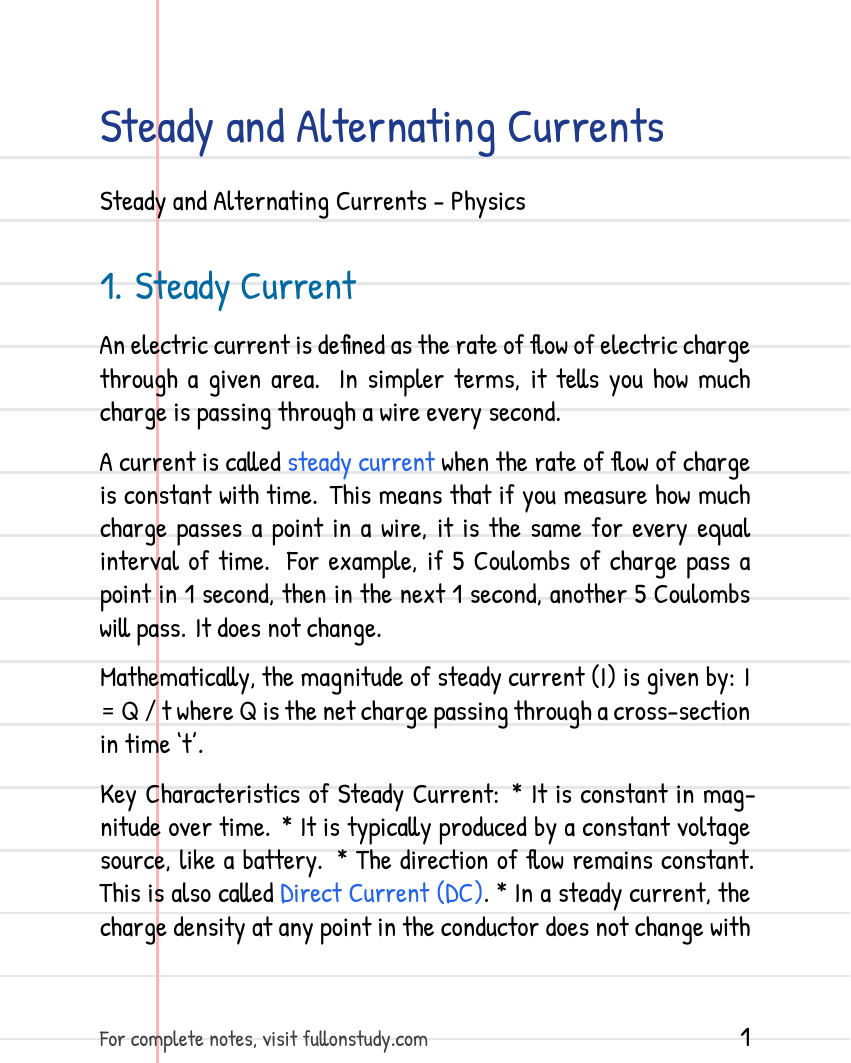
| Steady Current | Definition, constant flow of charge, relation to Direct Current (DC), mathematical formula (I = Q/t), key characteristics. |
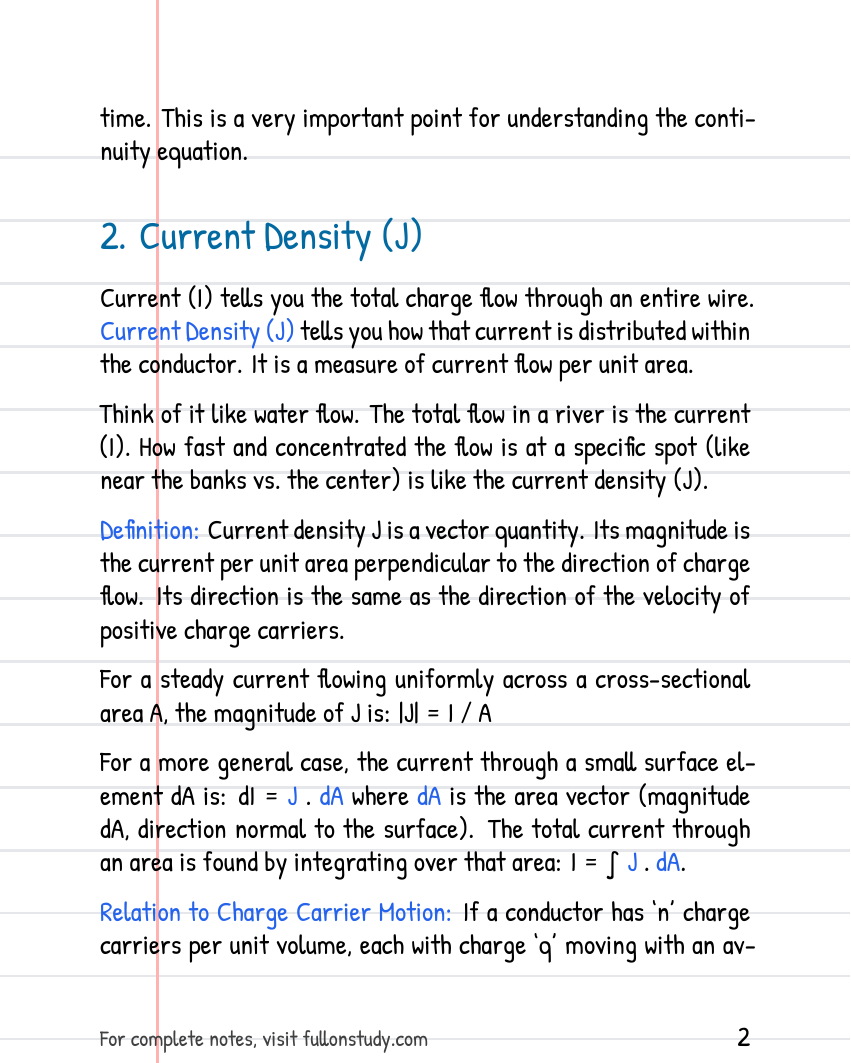
| Current Density (J) | Definition as a vector, difference from total current, analogy to water flow, formula for uniform flow ( |
Features
- Easy to understand explanations with simple analogies.
- Covers the complete syllabus for this topic.
- Free to download in pdf format for offline study.
- Includes questions and answers at the end of each topic for self-testing.
FAQs
What is the main difference between steady current and alternating current?
A steady current, also called Direct Current (DC), has a constant magnitude and direction over time. Alternating Current (AC) changes its magnitude and direction periodically.
What is current density and why is it important?
Current density tells you how the current is distributed within a conductor, not just the total flow. It’s a vector quantity important for understanding how electricity behaves in different materials and shapes.
Can I use these notes for my B.Sc. Physics exams?
Yes, these notes are designed to cover the core concepts of Steady and Alternating Currents typically found in B.Sc. Physics syllabi across Indian universities.
- 📄 Format PDF Document
- 🔓 Access Free
- 💾 File Size 0.15 MB
- 📖 Pages 30
- ✅ Reviewed By Manisha Joshi, M.Sc, Physics
- 🗓️ Last Updated April 20, 2026
×
![Preview enlarged]()