
Hey BSc Nursing student! Fluid and electrolyte imbalance shows up again and again in Adult Health Nursing I, both in theory papers and practical viva. These Nursing care of patients with common signs and symptoms and management notes are built around your exact university syllabus so you never waste time on irrelevant details. You will finally understand how to assess patients, interpret serum lab values, and plan safe nursing interventions without drowning in complex jargon. Use these notes alongside your clinical postings to spot early warning signs in real patients. And yes, you can download the free pdf to revise before your next exam.
What’s covered?
| Subtopic | What you’ll learn |
|---|---|
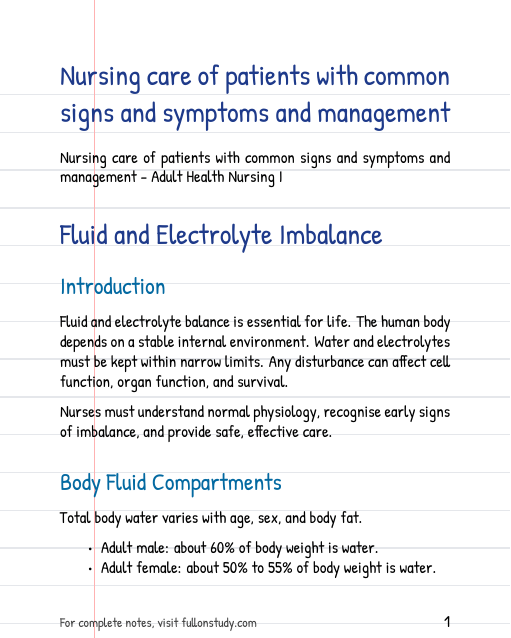
| Introduction to fluid and electrolyte balance | Why even small shifts in water and electrolytes can disrupt cell and organ function |
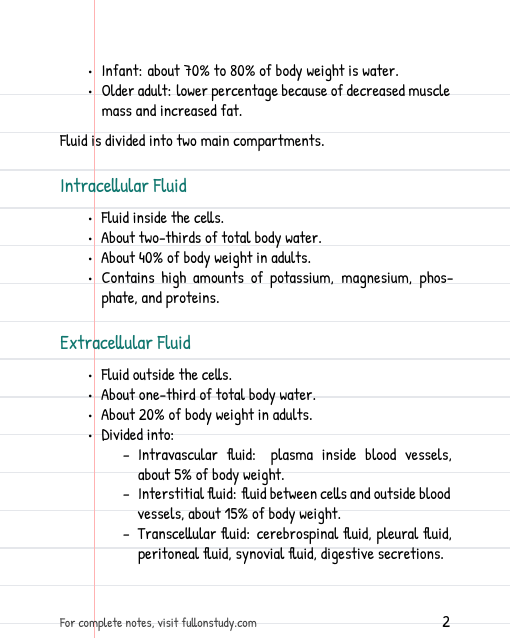
| Body fluid compartments | Distribution of intracellular, extracellular, and transcellular fluid across age groups |
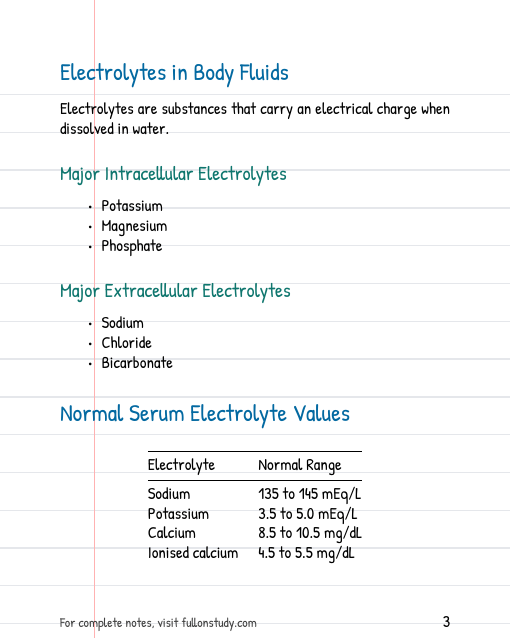
| Electrolytes in body fluids | Key intracellular and extracellular electrolytes and their physiological roles |
| Normal serum electrolyte values | Reference ranges for sodium, potassium, and other major electrolytes |
Features
- Simple explanation of fluid and electrolyte physiology with everyday examples for quick revision.
- Full syllabus alignment for BSc Nursing Adult Health Nursing I notes, covering every exam-relevant topic.
- Free pdf download formatted for mobile and print, so you can study anywhere.
- Step-by-step breakdown of nursing assessment, lab interpretation, and management priorities.
FAQs
- What are the most common signs of fluid volume deficit?
- Dry mucous membranes, decreased skin turgor, low blood pressure, and concentrated urine are classic signs. Nurses should monitor intake and output and daily weights.
- What is the normal range for serum potassium?
- Serum potassium normally ranges from 3.5 to 5.0 mEq/L. Values outside this range require immediate nursing assessment and possible ECG monitoring.
- How do you differentiate intracellular and extracellular fluid?
- Intracellular fluid is inside cells and rich in potassium, while extracellular fluid is outside cells and rich in sodium. Extracellular fluid includes intravascular, interstitial, and transcellular spaces.
- What nursing interventions help correct hyperkalemia?
- Administer prescribed potassium binders or insulin with glucose as ordered, restrict dietary potassium, and monitor cardiac rhythm closely. Always verify kidney function before giving potassium.
- Why is daily weight important in fluid imbalance?
- A sudden weight change of 1 kg usually reflects a gain or loss of 1 liter of body fluid. Daily weights at the same time each day give the most reliable hydration status.
- How does age affect total body water percentage?
- Infants have about 70-80% body water, adult males about 60%, adult females 50-55%, and older adults less due to decreased muscle mass and increased fat. This affects dosing and fluid needs.
- Where can I find these notes as a PDF?
- You can download the Nursing care of patients with common signs and symptoms and management pdf from the link provided after the article. It is free and formatted for printing.
- 📄 Format PDF Document
- 🔓 Access Free
- 💾 File Size 0.1 MB
- 📖 Pages 32
- ✅ Reviewed By Team Fullonstudy
- 🗓️ Last Updated September 7, 2026
×![Preview enlarged]()