
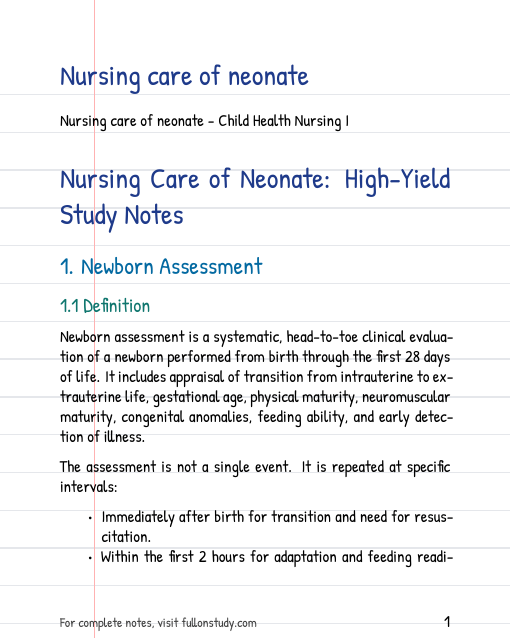
Hey BSc Nursing folks, if you are preparing for your Child Health Nursing I exams and clinicals, this set of Nursing care of neonate notes breaks down the basics without the fluff. Whether you are revising newborn assessment or trying to memorize classification cut-offs, these notes keep it exam-focused and easy to revisit. Keep these notes handy during clinical postings too.
What’s covered?
| Subtopic | Key focus |
|---|---|
| Newborn assessment | Definition, timing intervals, and systematic head-to-toe clinical evaluation |
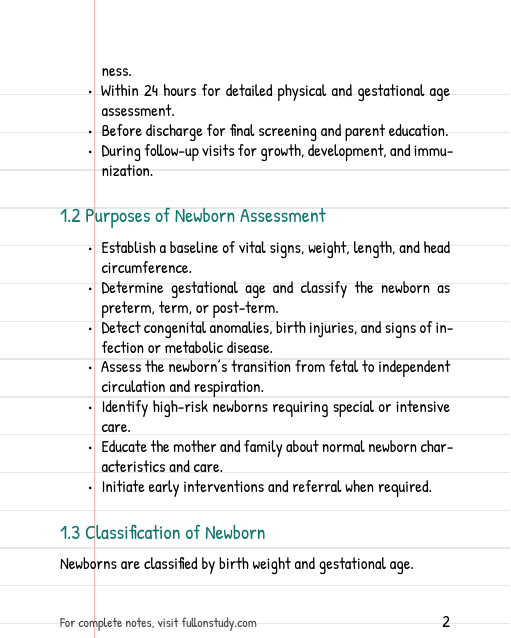
| Purposes of newborn assessment | Baseline data, gestational age, anomaly detection, and high-risk identification |
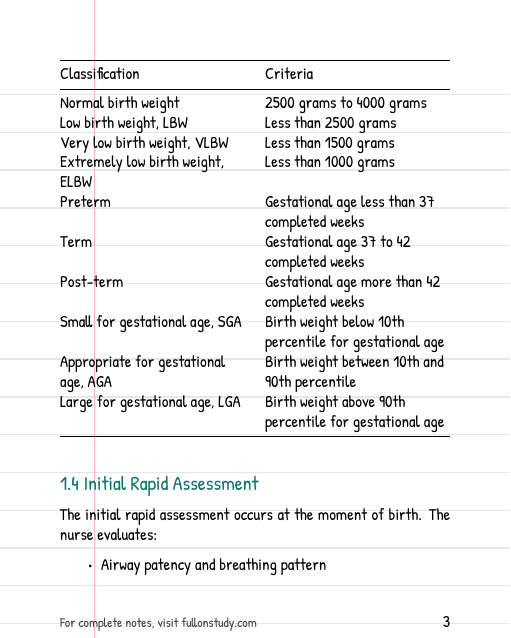
| Classification of newborn | Birth weight categories (LBW, VLBW, ELBW) and gestational age categories (preterm, term, post-term) |
Features
- Simple explanation of every core concept, written in straight language for nursing students.
- Full syllabus alignment for BSc Nursing Child Health Nursing I units and exam patterns.
- Step-by-step breakdowns from birth transition to discharge planning.
- Free PDF download of the complete Nursing care of neonate pdf for quick revision anytime.
FAQs
Q: What is the first priority in nursing care of a neonate immediately after birth? A: Establish airway, breathing, and circulation. Dry the baby, provide warmth, and assess Apgar score at 1 and 5 minutes.
Q: How do you classify a newborn with a birth weight of 2000 grams? A: That is low birth weight (LBW) because it is less than 2500 grams. It is not VLBW because VLBW starts below 1500 grams.
Q: What is the normal range for a term newborn’s length and head circumference? A: Length is usually 45 to 55 cm and head circumference 33 to 35 cm. These are baseline measurements for growth monitoring.
Q: Why is gestational age assessment important in neonatal care? A: It helps classify the baby as preterm, term, or post-term, which guides feeding, thermal care, and screening for complications.
Q: When should a newborn receive the first dose of vitamin K? A: Usually within the first hour after birth, given intramuscularly to prevent hemorrhagic disease of the newborn.
Q: What is the difference between LBW and preterm newborn? A: LBW is based only on weight (<2500 grams). Preterm is based on gestational age (<37 weeks). A baby can be both LBW and preterm, or LBW but term if growth restricted.
- 📄 Format PDF Document
- 🔓 Access Free
- 💾 File Size 0.22 MB
- 📖 Pages 64
- ✅ Reviewed By Team Fullonstudy
- 🗓️ Last Updated October 18, 2026