
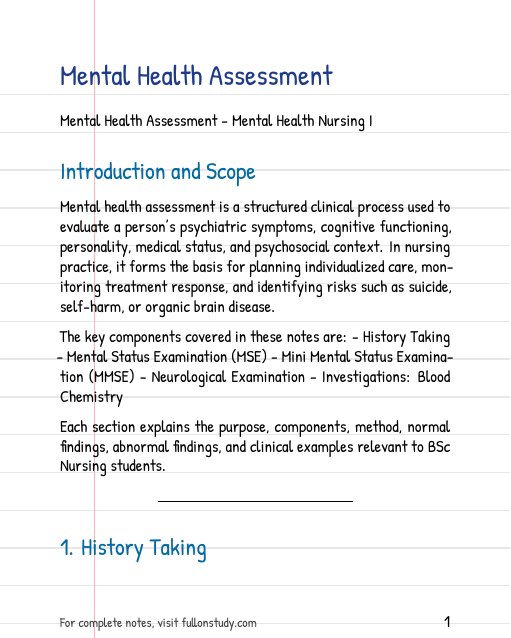
Hey BSc Nursing students, if Mental Health Nursing I has you wondering how to structure a psychiatric evaluation without missing a step, these BSc Nursing Mental Health Nursing I notes on Mental Health Assessment are for you. We have broken the whole process into clear, exam-ready sections so you can revise confidently before your practicals and theory papers.
What’s covered?
| Subtopic | What you’ll learn |
|---|---|
| History Taking | Systematic interview for psychiatric, medical, social, personal, and family history |
| Mental Status Examination (MSE) | Structured assessment of appearance, mood, thought, perception, and cognition |
| Mini Mental Status Examination (MMSE) | Quick cognitive screening for orientation, memory, attention, and language |
| Neurological Examination | Focused assessment of cranial nerves, motor, sensory, and coordination functions |
| Investigations: Blood Chemistry | Common lab tests to rule out organic causes of psychiatric symptoms |
Features
- Simple explanation: Each topic is broken into purpose, components, method, normal findings, and abnormal findings so you do not miss any exam question.
- Full syllabus alignment for BSc Nursing Mental Health Nursing I notes: The content follows the exact flow of your university syllabus.
- Free PDF download: You can download these Mental Health Assessment pdf notes for offline revision anytime.
- Step-by-step breakdowns: Learn how to perform each part of the assessment systematically, from history taking to neurological examination.
FAQs
What is mental health assessment in Mental Health Nursing I?
It is a structured clinical process to evaluate psychiatric symptoms, cognitive functioning, personality, medical status, and psychosocial context, forming the basis for individualized care planning.
What are the main components of mental health assessment?
The key components include history taking, mental status examination, mini mental status examination, neurological examination, and relevant blood chemistry investigations.
How is Mental Status Examination different from Mini Mental Status Examination?
MSE is a broad qualitative assessment of appearance, behavior, mood, thought, perception, and cognition, while MMSE is a brief standardized cognitive screening tool scored out of 30.
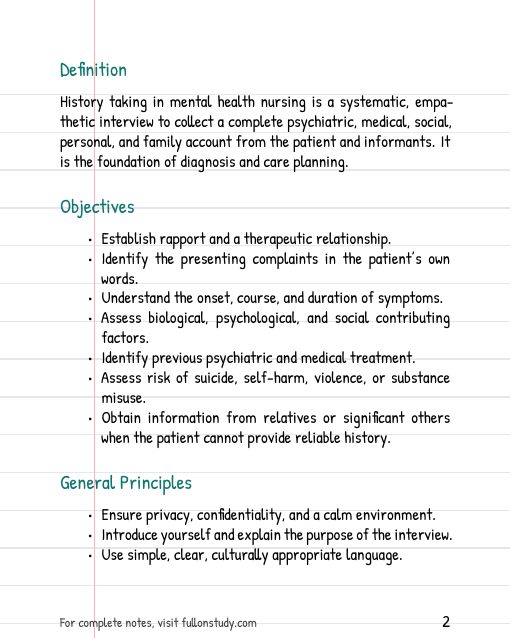
Why is history taking important in mental health nursing?
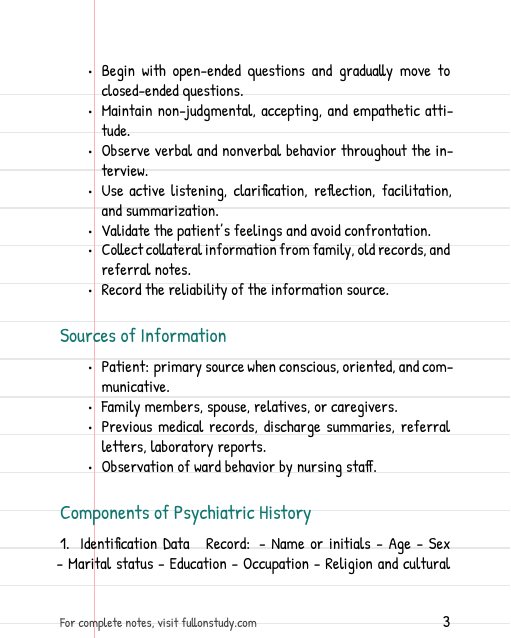
It helps establish rapport, identify presenting complaints, understand symptom onset and course, assess risk of suicide or self-harm, and gather information from relatives when the patient cannot provide reliable history.
What blood chemistry investigations are commonly done in mental health assessment?
Common tests include complete blood count, thyroid function tests, liver and kidney function tests, serum electrolytes, vitamin B12 and folate levels, and blood glucose to rule out organic causes.
How can I get a free PDF download of Mental Health Assessment notes for BSc Nursing?
You can access the complete Mental Health Assessment pdf from the download link on this page, absolutely free, for offline revision.
- 📄 Format PDF Document
- 🔓 Access Free
- 💾 File Size 0.15 MB
- 📖 Pages 38
- ✅ Reviewed By Team Fullonstudy
- 🗓️ Last Updated November 27, 2026