
Hey BSc Nursing student, preparing for Adult Health Nursing II and trying to wrap your head around emergency and disaster management? These notes are built to help you understand how nurses act fast, prioritize care, and manage large-scale crises without losing sight of the basics. Let’s get you exam-ready with clear, focused concepts.
What’s covered?
| Subtopic | What you’ll learn |
|---|---|
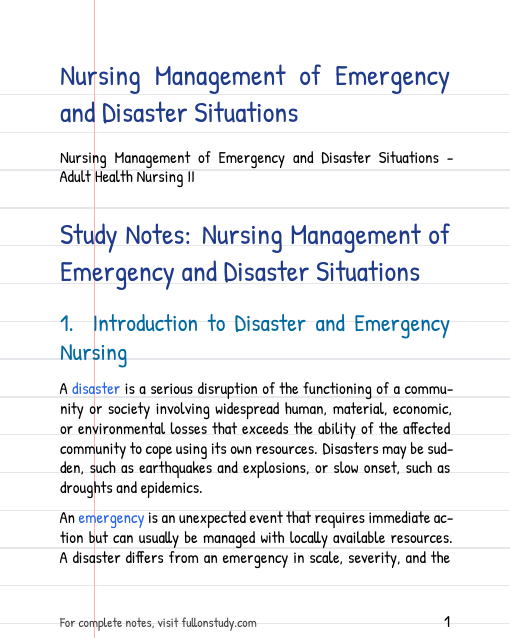
| Introduction to disaster and emergency nursing | Definitions, differences between disaster and emergency, and key characteristics of disasters. |
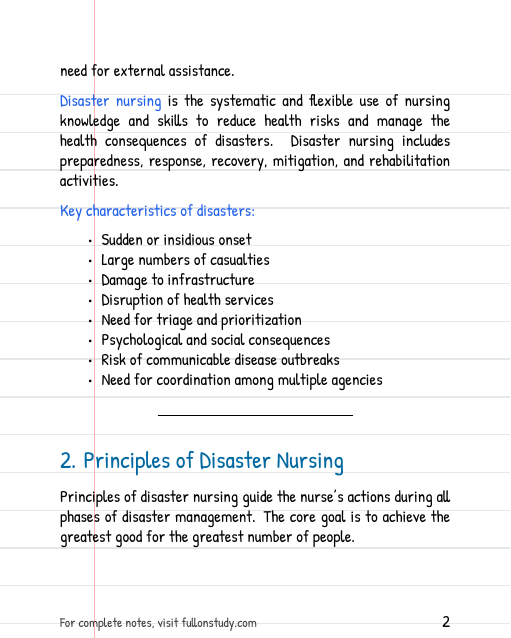
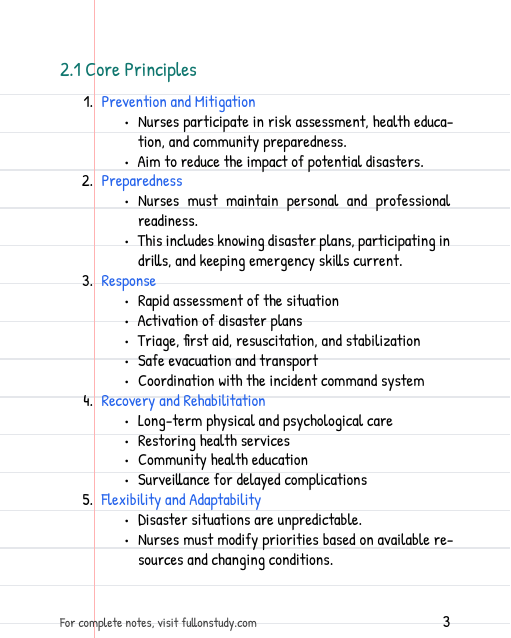
| Principles of disaster nursing | Core principles including prevention, mitigation, preparedness, response, and recovery. |
| Disaster nursing roles and responsibilities | How nurses participate in risk assessment, health education, and community preparedness. |
| Triage and prioritization | Why triage is necessary during mass casualty events and how nurses sort patients. |
| Overview of disaster phases | Preparedness, response, recovery, mitigation, and rehabilitation activities. |
Features
- Simple explanation with step-by-step breakdowns of nursing actions during emergencies.
- Fully covers the BSc Nursing Adult Health Nursing II syllabus.
- Includes a free pdf download for quick revision anytime.
- Clear separation of every phase, from preparedness to recovery.
- Written in simple, easy-to-understand language for faster learning.
FAQs
What is the difference between a disaster and an emergency in nursing? A disaster overwhelms local resources and needs external help, while an emergency can be managed with available resources. Nursing priorities shift toward mass casualty care in a disaster.
What are the core principles of disaster nursing? The core principles include prevention and mitigation, preparedness, response, recovery, and rehabilitation. Each phase guides the nurse’s role in reducing health risks.
How does triage work in disaster nursing? Triage sorts casualties based on urgency when resources are limited. The goal is to achieve the greatest good for the greatest number of people.
What is the nurse’s role in disaster preparedness? Nurses maintain personal readiness, know the disaster plan, participate in drills, and educate communities about risk reduction and emergency kits.
Why do disasters increase the risk of communicable disease outbreaks? Overcrowding, poor sanitation, disrupted health services, and lack of clean water create conditions where infections spread quickly. Nurses help prevent outbreaks through surveillance and hygiene education.
Where can I download the Nursing Management of Emergency and Disaster Situations notes PDF? You can get the Nursing Management of Emergency and Disaster Situations pdf from the free download section provided with these BSc Nursing Adult Health Nursing II notes.
- 📄 Format PDF Document
- 🔓 Access Free
- 💾 File Size 0.14 MB
- 📖 Pages 31
- ✅ Reviewed By Team Fullonstudy
- 🗓️ Last Updated September 25, 2026