
Hey BSc Nursing students, if Adult Health Nursing II has you juggling renal anatomy, physiology, and nursing care plans, this note set will make things clearer. I have put together the Nursing Management of Kidney and Urinary Disorders notes with an exam-first mindset. You can download the complete BSc Nursing Adult Health Nursing II notes as a free PDF at the end of this page.
What’s covered?
| Subtopic | What you’ll learn |
|---|---|
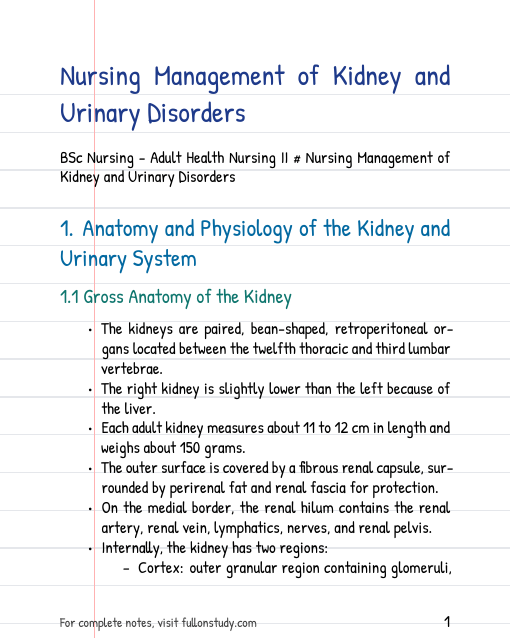
| Gross Anatomy of the Kidney | Location, external coverings, internal cortex and medulla, calyces, renal pelvis. |
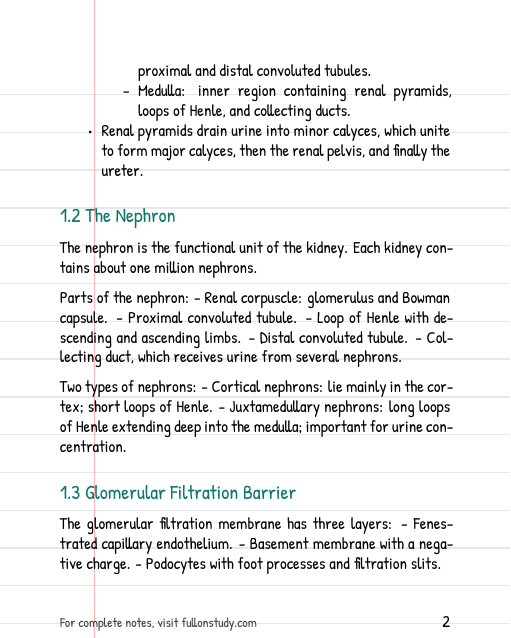
| The Nephron | Parts of the nephron, cortical vs juxtamedullary nephrons, urine formation pathways. |
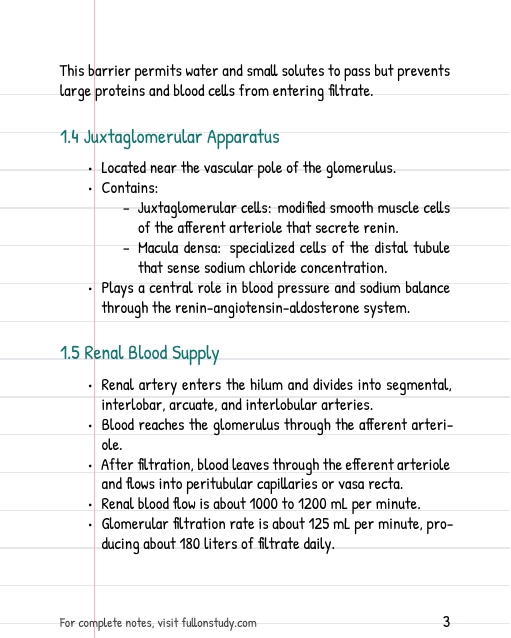
| Glomerular Filtration Barrier | Three layers, selective filtration, prevention of protein loss. |
Features
- Simple explanation of every renal structure and process.
- Full syllabus alignment for BSc Nursing Adult Health Nursing II.
- Free PDF download for offline revision and quick reference.
- Step-by-step breakdowns of nephron function and filtration layers.
- Quick revision pointers before exams and viva voce.
FAQs
What is the functional unit of the kidney?
The nephron is the functional unit. Each kidney contains about one million nephrons that filter blood and produce urine. It is the site of filtration, reabsorption, and secretion.
Why is the right kidney slightly lower than the left?
The right kidney sits lower because the liver occupies space above it on the right side. This position is useful when palpating the kidneys during abdominal assessment.
What are the three layers of the glomerular filtration barrier?
The barrier includes fenestrated capillary endothelium, a negatively charged basement membrane, and podocytes with filtration slits.
How do cortical and juxtamedullary nephrons differ?
Cortical nephrons have short loops of Henle mainly in the cortex, while juxtamedullary nephrons have long loops extending deep into the medulla for urine concentration.
What are common nursing management priorities for patients with kidney and urinary disorders?
Nurses monitor fluid balance, urine output, electrolyte levels, blood pressure, and signs of infection, while providing patient education on diet and medication adherence.
Where can I get the Nursing Management of Kidney and Urinary Disorders pdf?
You can download the complete Nursing Management of Kidney and Urinary Disorders pdf for free from the link provided in this article.
- 📄 Format PDF Document
- 🔓 Access Free
- 💾 File Size 0.12 MB
- 📖 Pages 33
- ✅ Reviewed By Team Fullonstudy
- 🗓️ Last Updated September 17, 2026