
Hey BSc Nursing student tackling Adult Health Nursing II, let’s make the nervous system feel a lot less intimidating. These Nursing Management of Neurological Disorders notes break down the core anatomy and physiology you need before diving into patient care. Whether you’re preparing for exams or clinical postings, this guide gives you a clear starting point.
What’s covered?
| Subtopic | What you’ll learn |
|---|---|
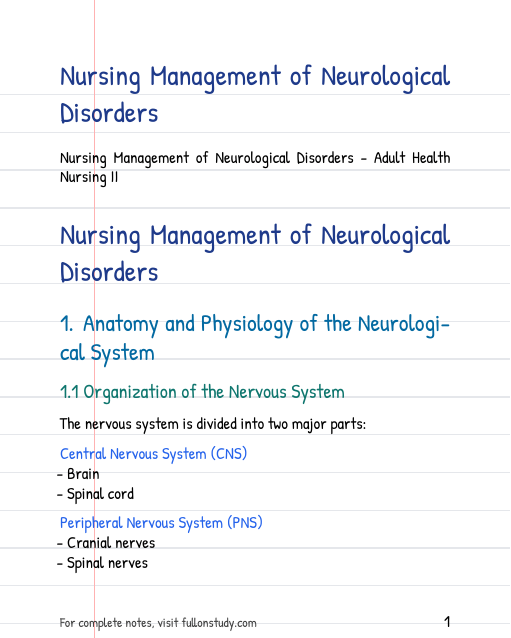
| Organization of the Nervous System | CNS (brain, spinal cord) and PNS (cranial, spinal, autonomic, somatic nerves) |
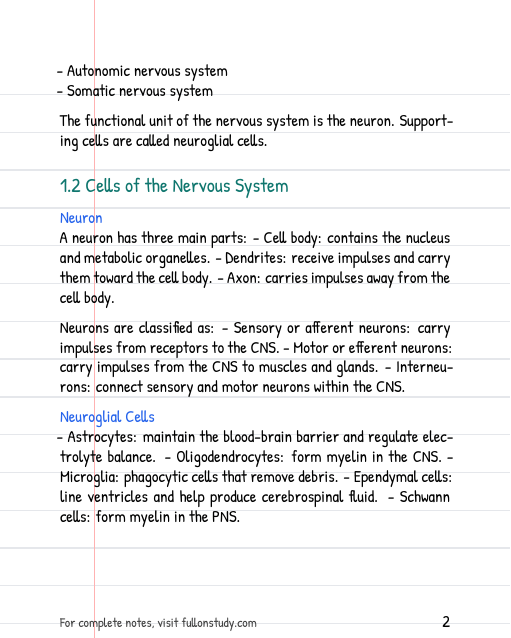
| Cells of the Nervous System | Neuron parts and classifications; types of neuroglial cells and their roles |
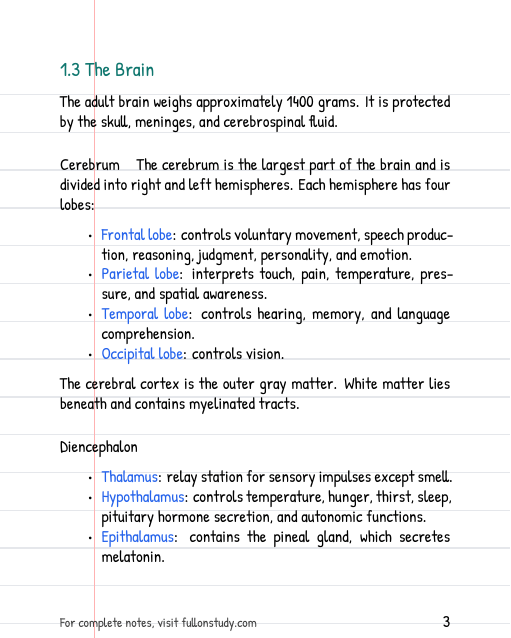
| The Brain | Brain weight, protective structures, and cerebrum hemispheres |
| Cerebrum Lobes | Frontal, parietal, temporal, and occipital lobe functions |
Features
- Simple explanations that turn complex neurological concepts into easy-to-grasp ideas.
- Full syllabus alignment for BSc Nursing Adult Health Nursing II.
- Free PDF download so you can study offline anytime.
- Step-by-step breakdowns from basic anatomy to clinical nursing management.
FAQs
What is the difference between CNS and PNS?
The central nervous system includes the brain and spinal cord, while the peripheral nervous system includes all nerves outside the CNS, such as cranial and spinal nerves, and the autonomic and somatic systems.
How are neurons classified?
Neurons are classified as sensory (afferent), motor (efferent), and interneurons. Sensory neurons carry impulses to the CNS, motor neurons carry impulses away, and interneurons connect them.
What do neuroglial cells do?
Neuroglial cells support neurons. Astrocytes maintain the blood-brain barrier, oligodendrocytes form myelin in the CNS, microglia remove debris, ependymal cells produce cerebrospinal fluid, and Schwann cells form myelin in the PNS.
What are the four lobes of the cerebrum and their functions?
Frontal lobe controls voluntary movement and reasoning, parietal lobe interprets touch and pain, temporal lobe handles hearing and memory, and occipital lobe processes vision.
What is cerebrospinal fluid and why is it important?
Cerebrospinal fluid cushions the brain and spinal cord, removes waste, and helps maintain a stable environment for neural function.
How can I download Nursing Management of Neurological Disorders pdf?
You can get the free PDF download from this page. It covers all key topics aligned with BSc Nursing Adult Health Nursing II notes for quick revision.
- 📄 Format PDF Document
- 🔓 Access Free
- 💾 File Size 0.19 MB
- 📖 Pages 53
- ✅ Reviewed By Team Fullonstudy
- 🗓️ Last Updated September 21, 2026