
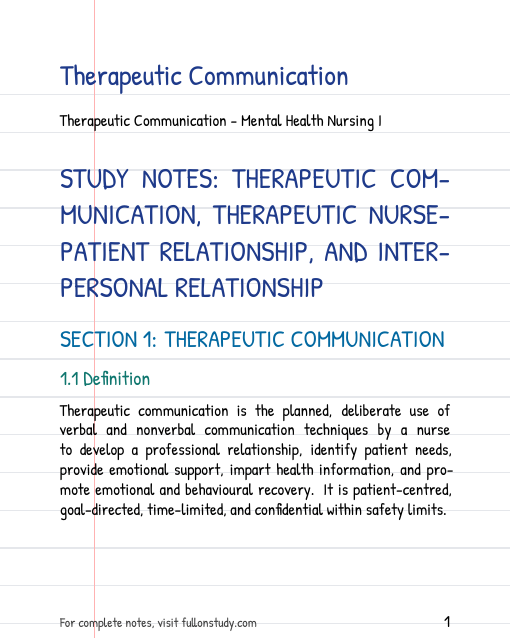
If you’re studying Mental Health Nursing I as a BSc Nursing student, therapeutic communication is one of those high-yield topics that shows up everywhere, from theory papers and clinical viva to practical OSCE stations. These Therapeutic Communication notes break down the core ideas without overcomplicating things, so you can revise faster and with more confidence. You’ll see exactly how nurses use planned verbal and nonverbal techniques to build trust, reduce patient anxiety, and support emotional recovery.
What’s covered?
| Subtopic | Key focus |
|---|---|
| Definition of Therapeutic Communication | Planned, patient-centered interaction for emotional and behavioral recovery |
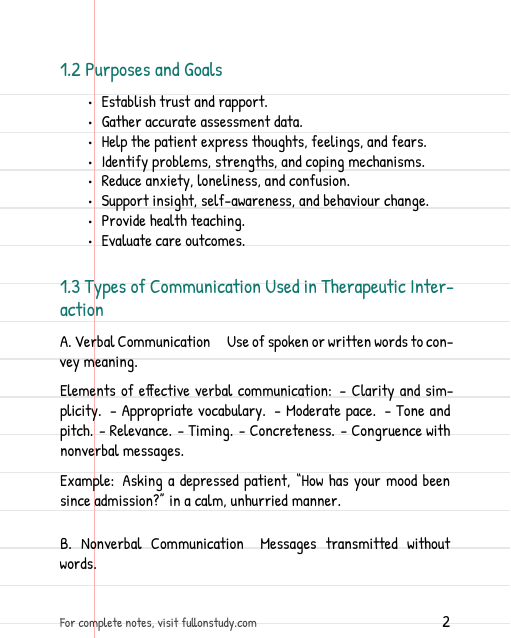
| Purposes and Goals | Trust building, data collection, anxiety reduction, and health teaching |
| Verbal Communication | Clarity, vocabulary, pace, tone, and congruence with nonverbal cues |
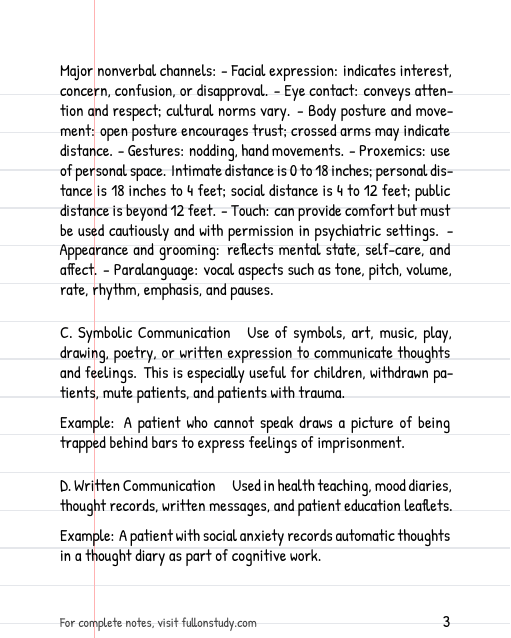
| Nonverbal Communication | Facial expression, eye contact, posture, gestures, proxemics, and touch |
Features
- Simple explanation of therapeutic communication concepts so you can revise quickly.
- Full syllabus alignment for BSc Nursing Mental Health Nursing I.
- Free PDF download available for offline study and last-minute revision.
- Step-by-step breakdowns of verbal and nonverbal communication techniques.
FAQs
What is therapeutic communication in mental health nursing?
Therapeutic communication is a goal-directed, planned interaction between a nurse and patient to identify needs, provide emotional support, and promote recovery.
Why is therapeutic communication a core topic in BSc Nursing Mental Health Nursing I?
It forms the foundation for building trust with psychiatric patients and is frequently tested in theory exams, practicals, and clinical postings.
What are the main types of communication used in therapeutic interaction?
The two main types are verbal communication, using spoken or written words, and nonverbal communication, including facial expressions, eye contact, posture, gestures, and use of personal space.
What are the key purposes of therapeutic communication?
Purposes include establishing rapport, gathering accurate assessment data, reducing patient anxiety, helping patients express feelings, and teaching health information.
How do I get the Therapeutic Communication PDF notes for free?
Scroll down to the download section on this page to access the free PDF download of these BSc Nursing Mental Health Nursing I notes.
What are some common therapeutic communication techniques?
Common techniques include active listening, using open-ended questions, reflecting patient feelings, paraphrasing, clarifying, and maintaining appropriate eye contact and personal space. These skills are tested frequently in Mental Health Nursing I practical exams.
- 📄 Format PDF Document
- 🔓 Access Free
- 💾 File Size 0.12 MB
- 📖 Pages 27
- ✅ Reviewed By Team Fullonstudy
- 🗓️ Last Updated November 27, 2026