
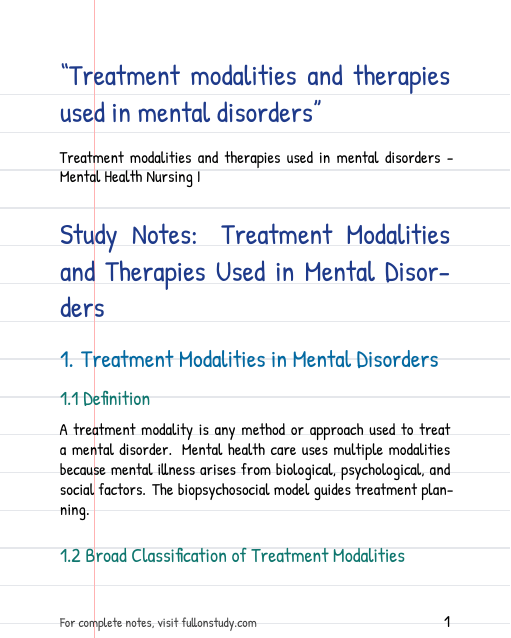
As a BSc Nursing student tackling Mental Health Nursing I, understanding treatment modalities is essential for patient care and exams. These notes break down every major therapy and the principles behind choosing them in a way that actually sticks.
What’s covered?
| Subtopic | What you’ll learn |
|---|---|
| Definition of treatment modalities | What counts as a treatment modality and why the biopsychosocial model matters |
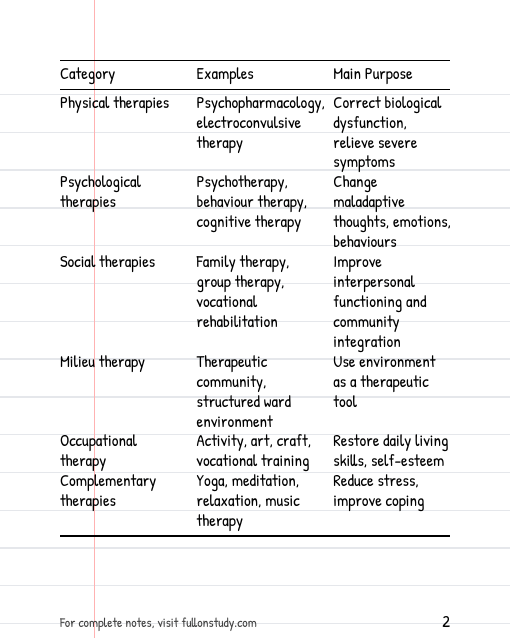
| Broad classification | Physical, psychological, social, milieu, occupational, and complementary therapies |
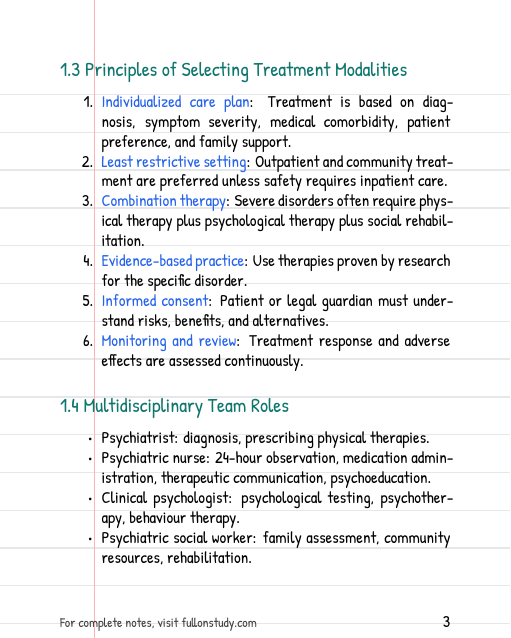
| Principles of selection | Individualized care, least restrictive setting, combination therapy, evidence-based practice, informed consent |
Features
- Simple explanation of each therapy class, tailored for nursing students.
- Full syllabus alignment with BSc Nursing Mental Health Nursing I.
- Free PDF download to study offline or print for notes.
- Step-by-step breakdown of classification and selection principles.
FAQs
Q: What are the main treatment modalities for mental disorders? A: They include physical therapies like psychopharmacology and ECT, psychological therapies like CBT, social therapies like family therapy, milieu therapy, occupational therapy, and complementary therapies like yoga and meditation.
Q: Why is combining different treatment modalities important? A: Mental disorders have biological, psychological, and social causes. Combining therapies addresses all these factors and improves overall recovery.
Q: What does least restrictive setting mean in treatment planning? A: It means using outpatient or community treatment whenever possible, and only using inpatient care when safety requires it.
Q: What is the biopsychosocial model? A: It is a framework that views mental illness as caused by biological, psychological, and social factors, guiding comprehensive treatment plans.
Q: How do nurses evaluate the effectiveness of a treatment modality? A: Nurses monitor symptom reduction, functional improvement, medication side effects, and patient feedback, then adjust the care plan with the team.
Q: Which treatment modality is best for severe depression? A: Severe depression often requires a combination of antidepressant medication and psychotherapy, and sometimes ECT if symptoms are treatment-resistant.
- 📄 Format PDF Document
- 🔓 Access Free
- 💾 File Size 0.29 MB
- 📖 Pages 77
- ✅ Reviewed By Team Fullonstudy
- 🗓️ Last Updated November 28, 2026