
These notes explain how combining simple harmonic motions works and introduces Lissajous figures. Perfect for physics students who need clear explanations of these important concepts.
What’s covered?
| Topic | Description |
|---|---|
| Superposition of Two SHMs (Same Frequency, Same Line) | Explains the principle of superposition and how to combine two simple harmonic motions mathematically. |
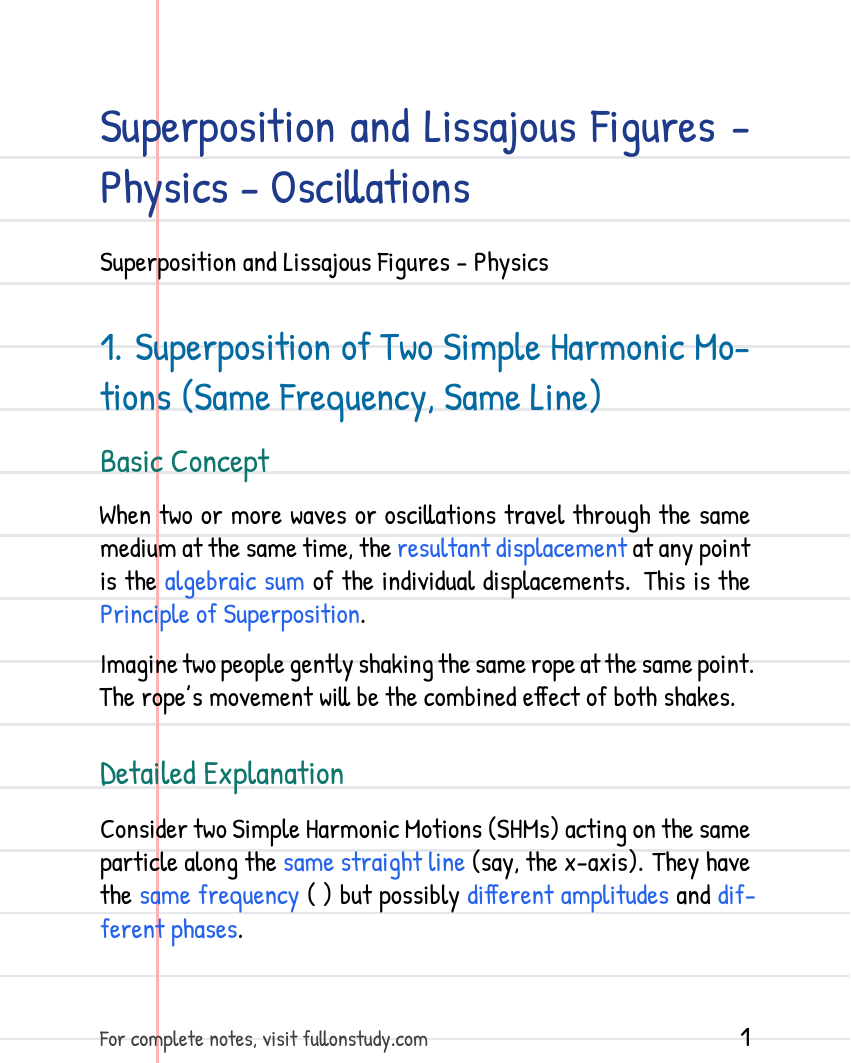
| Basic Concept | Defines superposition as the algebraic sum of individual displacements when waves or oscillations travel together. |
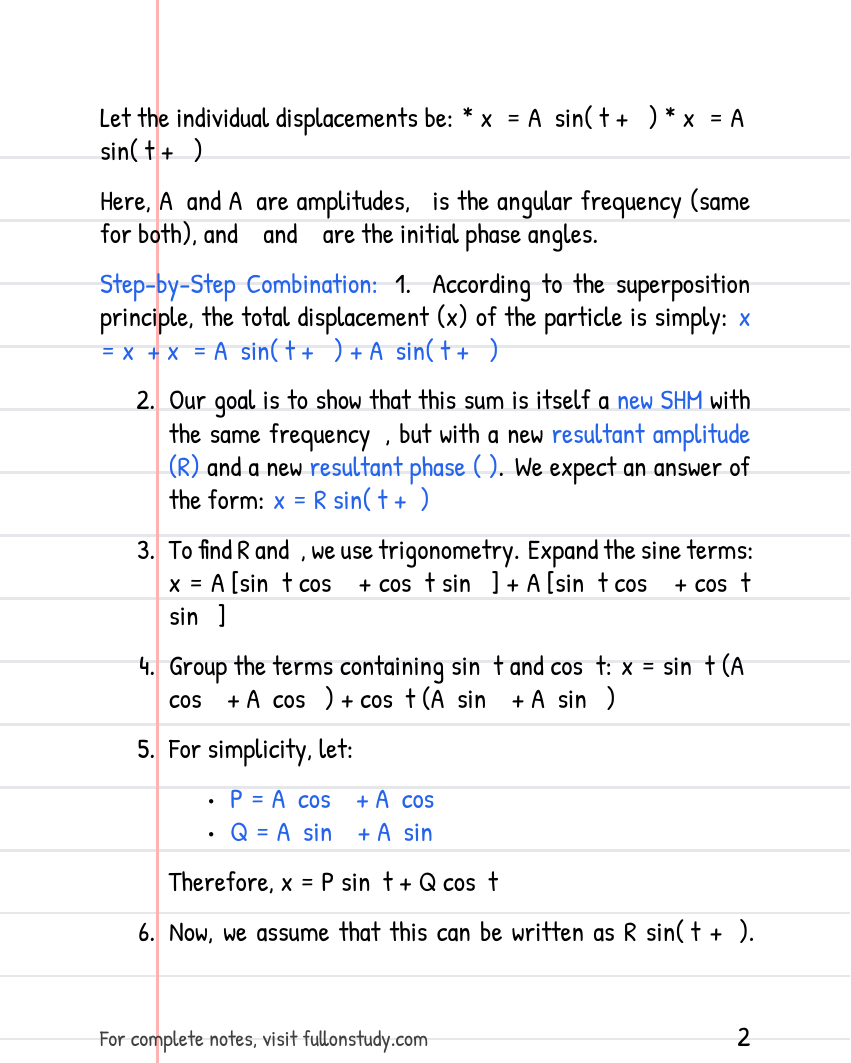
| Detailed Explanation | Shows step-by-step combination of two SHMs with same frequency but different amplitudes and phases. |
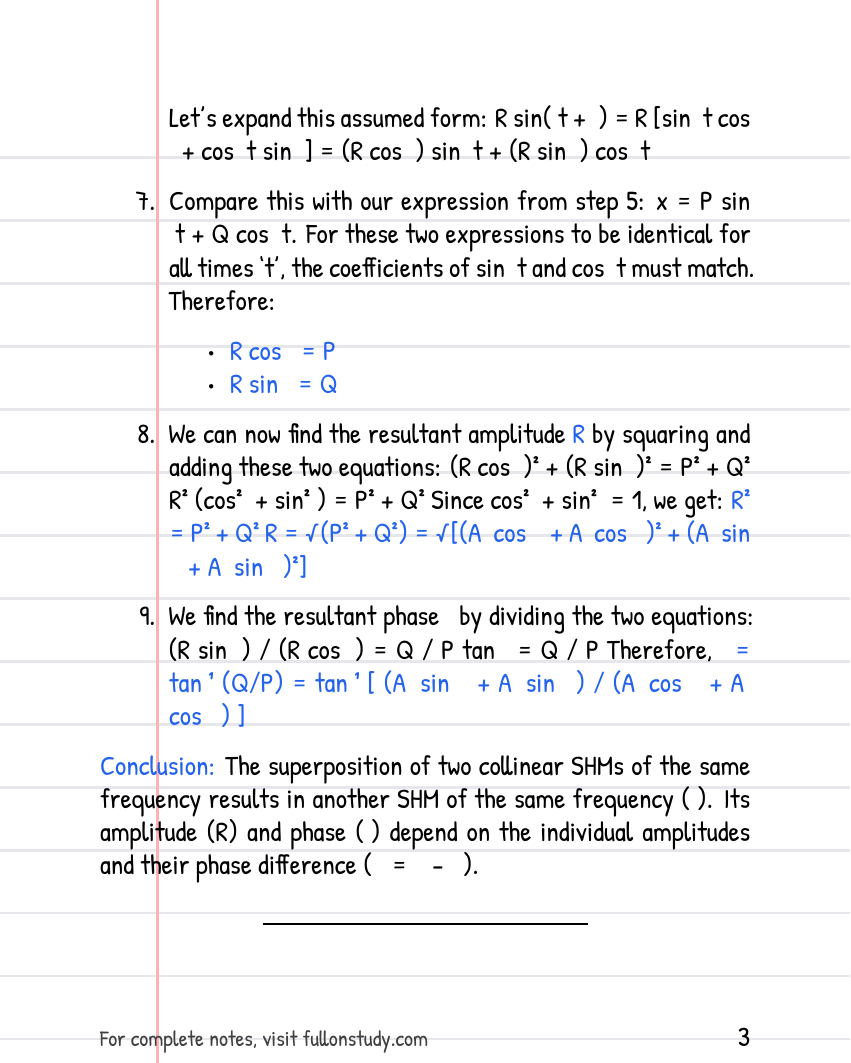
| Trigonometric Derivation | Demonstrates how to find resultant amplitude and phase using trigonometry. |
Features
- Easy to understand explanations with simple examples
- Complete syllabus coverage for university physics courses
- Free to download in pdf format for offline study
- Questions and answers at the end of each topic for practice
FAQs
What is the principle of superposition?
It states that when two or more waves or oscillations travel through the same medium at the same time, the resultant displacement is the algebraic sum of the individual displacements.
What happens when you combine two SHMs with the same frequency?
The result is another simple harmonic motion with the same frequency, but with a new resultant amplitude and phase.
Are these notes useful for exams?
Yes, these Superposition and Lissajous Figures notes cover essential physics concepts that frequently appear in university exams and assignments.
Download PDF
- Format PDF Document
- Access Free
- File Size 0.04 MB
- Pages 5
- Reviewed By Manisha Joshi, M.Sc, Physics
- Last Updated April 7, 2026
×
![]()