
If you’re a BSc Nursing student wanting clear, exam-focused notes on Drugs used for pregnant women during antenatal, labour and postnatal period, you’re in the right place. These BSc Nursing Pharmacology II notes pull together the must-know drug categories and immunization schedules in one clean overview. Use this to revise quickly before your internal assessments or university exams.
What’s covered?
| Subtopic | What you’ll learn |
|---|---|
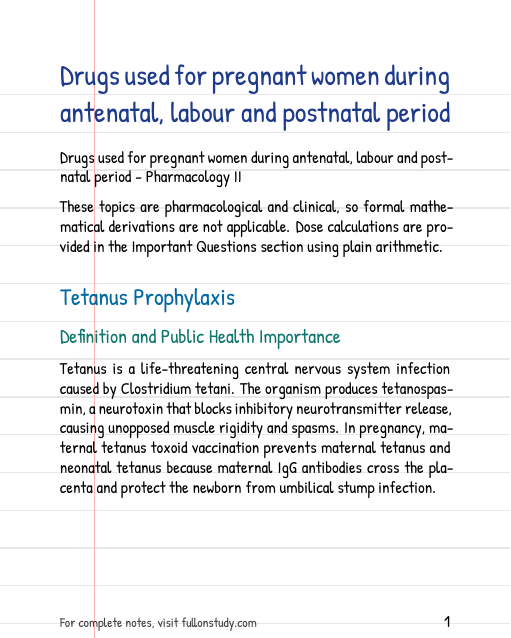
| Tetanus prophylaxis in pregnancy | Why tetanus toxoid is given, its public health importance, and how maternal vaccination prevents neonatal tetanus. |
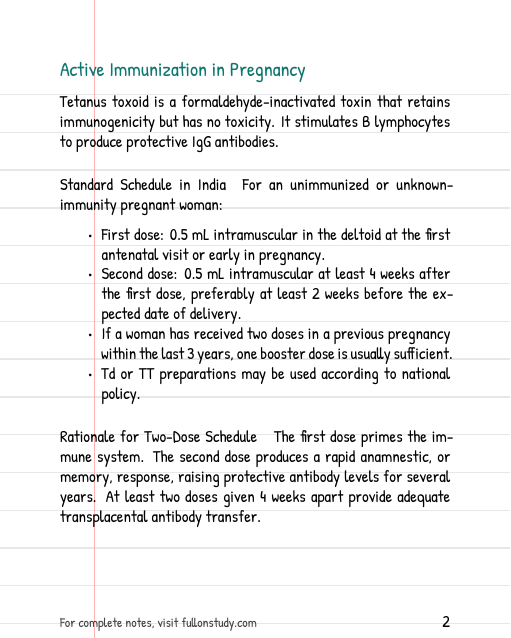
| Active immunization schedule | Standard two-dose TT/Td schedule in India, timing, and booster dose guidance. |
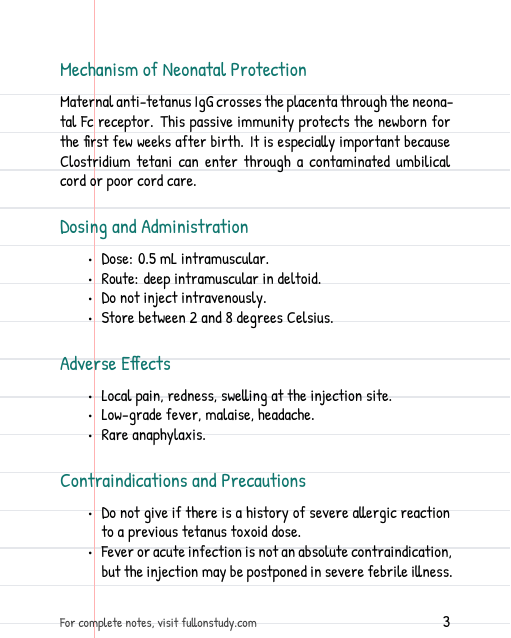
| Mechanism of neonatal protection | How maternal IgG crosses the placenta through the neonatal Fc receptor. |
| Dose calculations | Exam-style arithmetic problems covered in the Important Questions section. |
Features
- Simple explanation of every key drug and immunization concept for pregnancy, labour, and postnatal care.
- Full syllabus alignment for BSc Nursing Pharmacology II, so you don’t waste time on extra topics.
- Free PDF download of these Drugs used for pregnant women during antenatal, labour and postnatal period pdf for offline study.
- Step-by-step breakdowns of schedules, mechanisms, and dose calculations.
FAQs
1. What is the standard tetanus toxoid schedule for pregnant women in India?
For an unimmunized pregnant woman, give 0.5 mL TT intramuscular at the first antenatal visit, then a second 0.5 mL dose at least 4 weeks later and at least 2 weeks before delivery.
2. Why are two doses of tetanus toxoid needed during pregnancy?
The first dose primes the immune system, and the second triggers a rapid memory response that produces protective antibody levels for several years and ensures adequate placental transfer.
3. How does maternal tetanus vaccination protect the newborn?
Maternal anti-tetanus IgG crosses the placenta through the neonatal Fc receptor, giving passive immunity to the baby and preventing neonatal tetanus from umbilical stump infection.
4. Which drugs are commonly used to induce or augment labour?
Common agents include oxytocin for induction or augmentation and prostaglandins like misoprostol or dinoprostone for cervical ripening.
5. What drug is typically used to prevent postpartum hemorrhage?
Oxytocin is the first-line drug to prevent and treat postpartum hemorrhage by promoting uterine contraction. Sometimes misoprostol or ergometrine is used.
6. Which supplement is routinely given during the antenatal period to prevent anemia?
Ferrous sulphate with folic acid tablets are routinely provided to all pregnant women to prevent maternal anemia and neural tube defects.
- 📄 Format PDF Document
- 🔓 Access Free
- 💾 File Size 0.06 MB
- 📖 Pages 15
- ✅ Reviewed By Team Fullonstudy
- 🗓️ Last Updated September 15, 2026