
These notes cover the fundamental concepts of fluid mechanics from the Properties of Matter physics course. They explain how fluid motion is described and classified in simple terms.
What’s covered?
| Topic | Description |
|---|---|
| Kinematics of Moving Fluids | Study of fluid motion without considering forces |
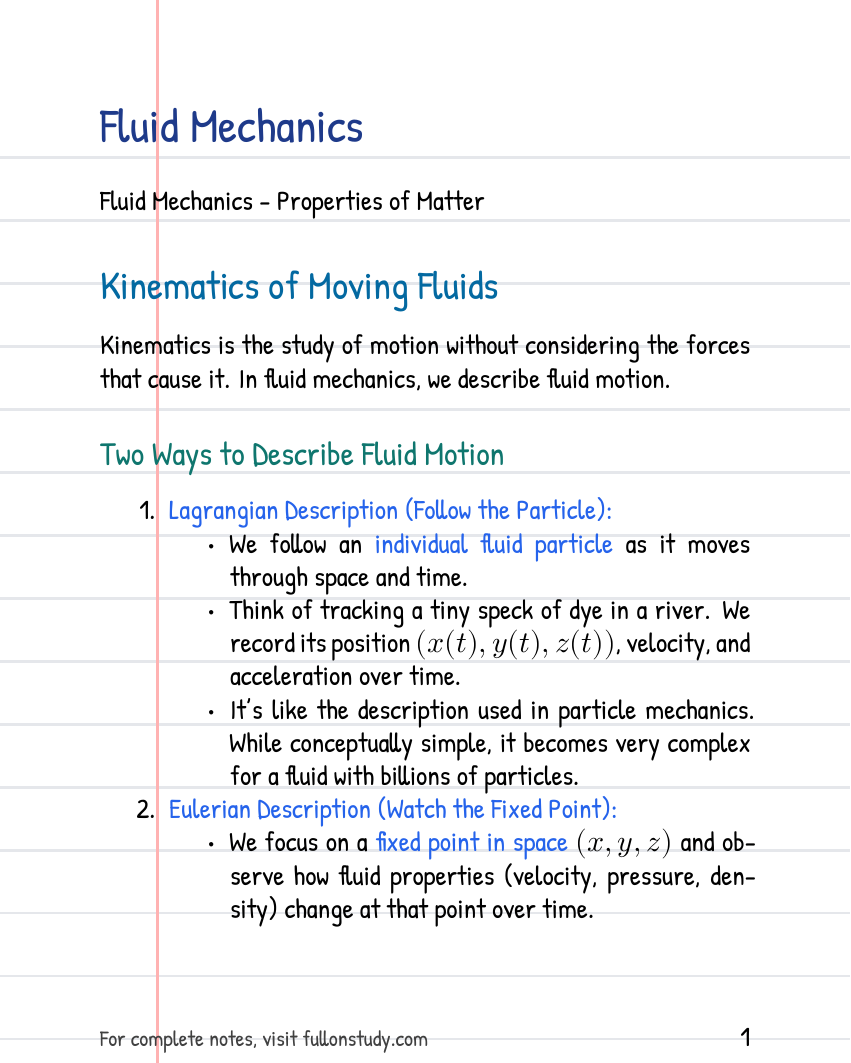
| Lagrangian Description | Following individual fluid particles through space and time |
| Eulerian Description | Observing fluid properties at fixed points in space |
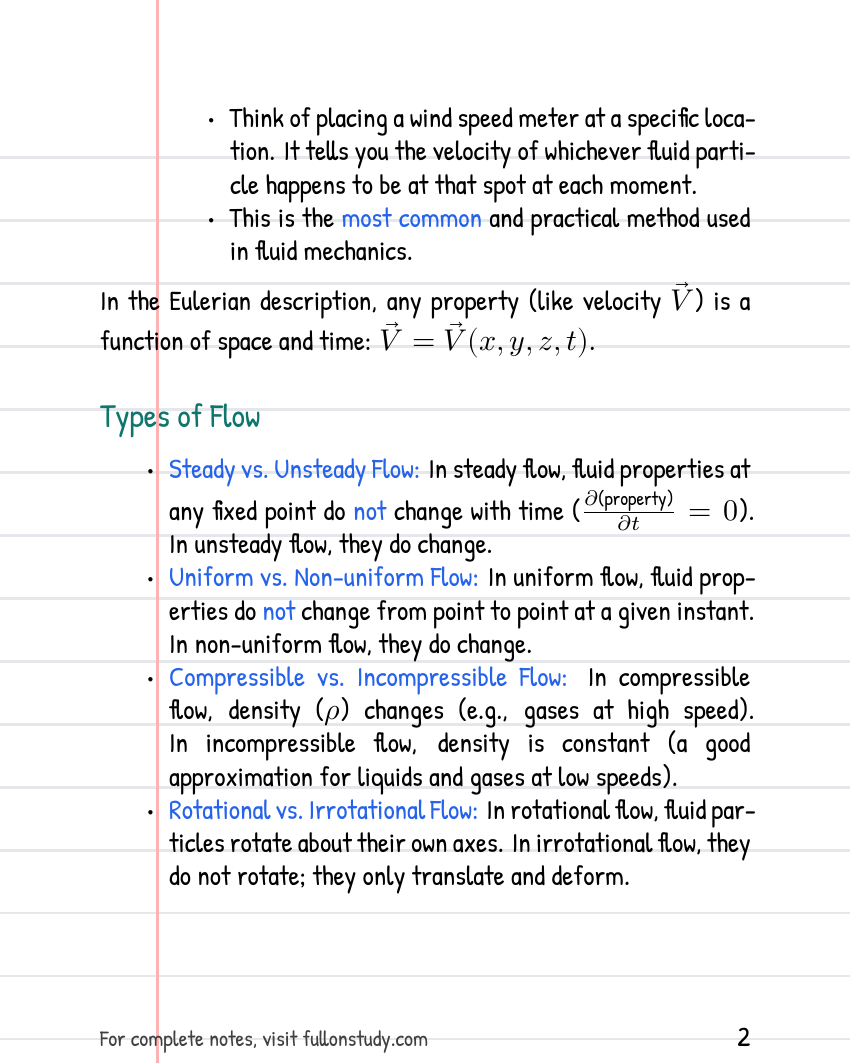
| Types of Flow | Classification including steady/unsteady, uniform/non-uniform, compressible/incompressible, and rotational/irrotational flow |
Features
- Easy to understand explanations with practical examples
- Complete syllabus coverage for university physics courses
- Free to download in pdf format for offline study
- Questions and answers at the end of each topic for self-assessment
FAQs
What is the difference between Lagrangian and Eulerian descriptions?
The Lagrangian description follows individual fluid particles as they move, while the Eulerian description observes fluid properties at fixed points in space. The Eulerian method is more commonly used in practice.
What are the main types of fluid flow?
Fluid flow can be classified as steady or unsteady, uniform or non-uniform, compressible or incompressible, and rotational or irrotational. These classifications help analyze different fluid behaviors.
Are these notes suitable for my university course?
Yes, these Fluid Mechanics – Physics – Properties of Matter notes cover standard topics for BSc Physics and Engineering students. They provide clear explanations of fundamental concepts that appear in most university syllabi.
- 📄 Format PDF Document
- 🔓 Access Free
- 💾 File Size 0.07 MB
- 📖 Pages 9
- ✅ Reviewed By Manisha Joshi, M.Sc, Physics
- 🗓️ Last Updated April 14, 2026