
Your chemistry exam is close, and your notes are scattered across a textbook, a lecture copy and a friend’s phone photos.
These BSc 2nd year chemistry notes bring Inorganic, Organic and Physical Chemistry together, chapter by chapter.
Each paper is a separate PDF, so you can download only what you need and start revising today.
Jump straight to a paper: Inorganic Chemistry, Organic Chemistry or Physical Chemistry.
What Are BSc 2nd Year Chemistry Notes?
BSc 2nd year chemistry notes are chapter-wise study material covering the three core branches of the syllabus: Inorganic, Organic and Physical Chemistry.
They break each topic into short, exam-ready explanations so you can learn the concepts and revise fast before university exams.
Think of them as a revision companion. They work best next to your prescribed textbook, not instead of it.
What Is Inside These Chemistry Notes?
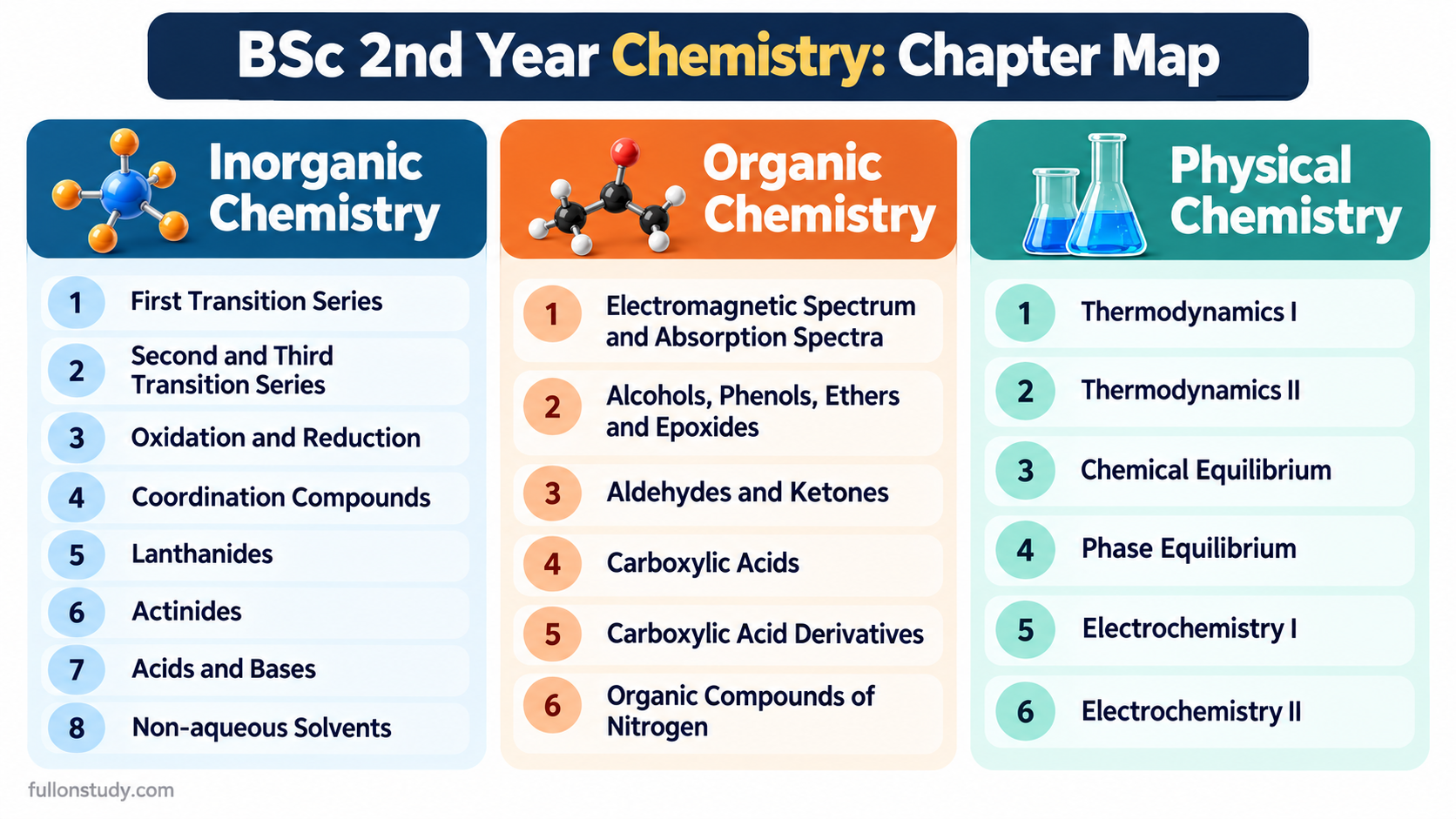
Here is a quick view of what each paper covers. Chapter names follow the PDFs, so check them against your own university syllabus.
| Paper | Main topics covered | Good to know |
|---|---|---|
| Inorganic Chemistry | Transition elements, oxidation and reduction, coordination compounds, lanthanides, actinides, acids and bases, non-aqueous solvents | Heavy on theory and definitions |
| Organic Chemistry | Spectroscopy basics, alcohols, phenols, ethers, aldehydes, ketones, carboxylic acids and their derivatives, nitrogen compounds | Reactions and mechanisms need regular practice |
| Physical Chemistry | Thermodynamics, chemical equilibrium, phase equilibrium, electrochemistry | Formulas and numericals matter most |
Inorganic Chemistry Notes for BSc 2nd Year
Inorganic Chemistry rewards students who understand patterns. Once you see why elements behave the way they do, the facts stop feeling like a long list.
The Inorganic PDF includes these chapters:
- Chemistry of Elements of the First Transition Series
- Chemistry of Elements of the Second and Third Transition Series
- Oxidation and Reduction
- Coordination Compounds
- Chemistry of Lanthanide Elements
- Chemistry of Actinides
- Acids and Bases
- Non-aqueous Solvents
| Unit | Title | Download Link |
|---|---|---|
| 1 | Chemistry of Elements of First Transition Series | Download |
| 2 | Chemistry of Elements of Second and Third Transition Series | Download |
| 3 | Oxidation and Reduction | Download |
| 4 | Coordination Compounds | Download |
| 5 | Chemistry of Lanthanide Elements | Download |
| 6 | Chemistry of Actinides | Download |
| 7 | Acids and Bases | Download |
| 8 | Non-aqueous Solvents | Download |
Coordination Compounds: The Chapter to Master First
This chapter is a favourite in exams, and it connects to the transition element chapters before it.
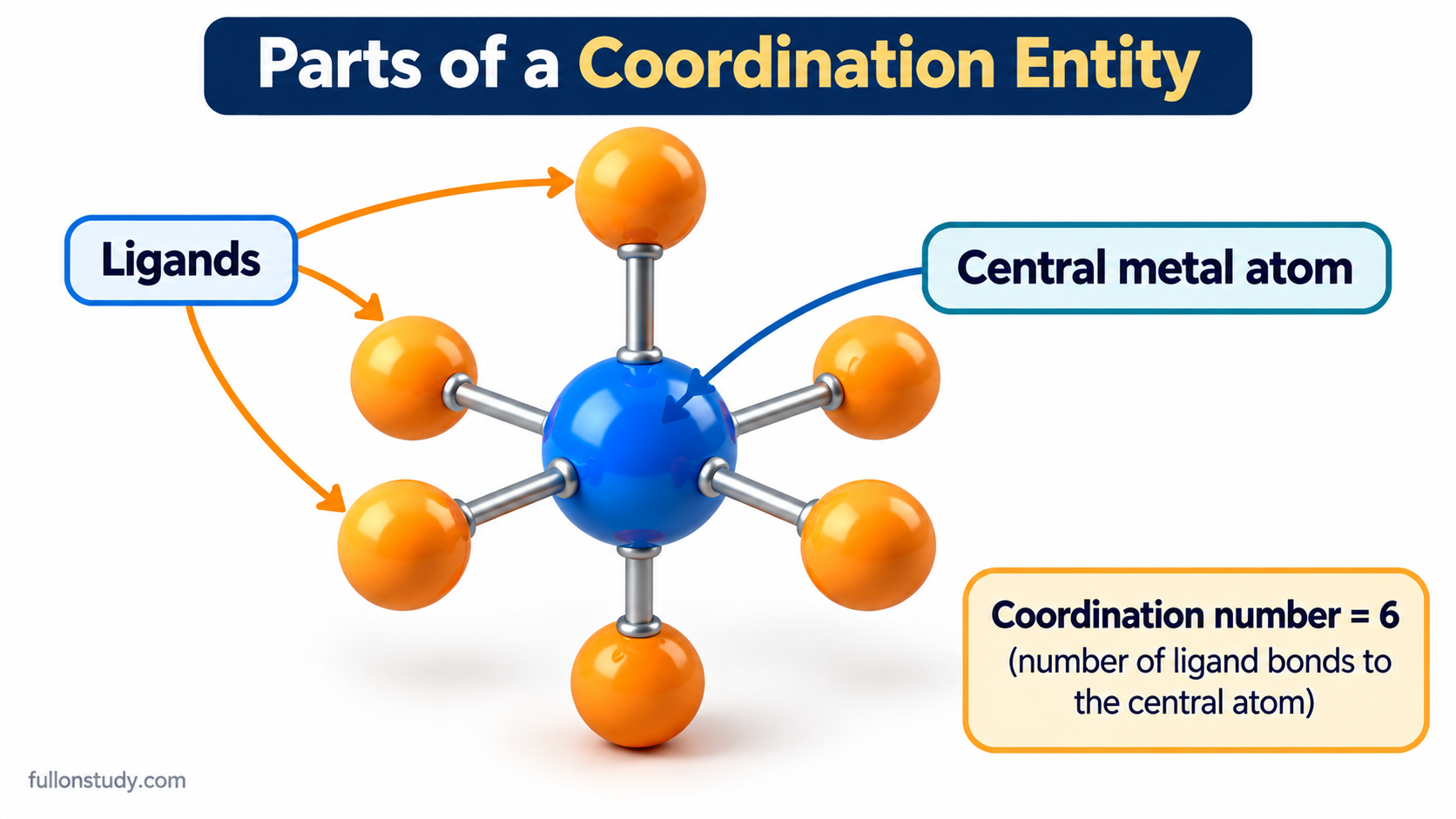
IUPAC describes a coordination entity as a central atom, usually a metal, with a surrounding array of ligands attached to it.
Start with that picture. Nomenclature, isomerism and bonding theories all build on it.
Acids and Bases: Know your Definitions
Examiners often ask you to compare definitions. According to IUPAC, a Brønsted acid is a molecular entity that can donate a hydron (proton) to a base.
Write that definition in your own words once. It will stick far better than reading it five times.
Organic Chemistry Notes for BSc 2nd Year
Organic Chemistry is about understanding why a reaction happens, not memorising it.
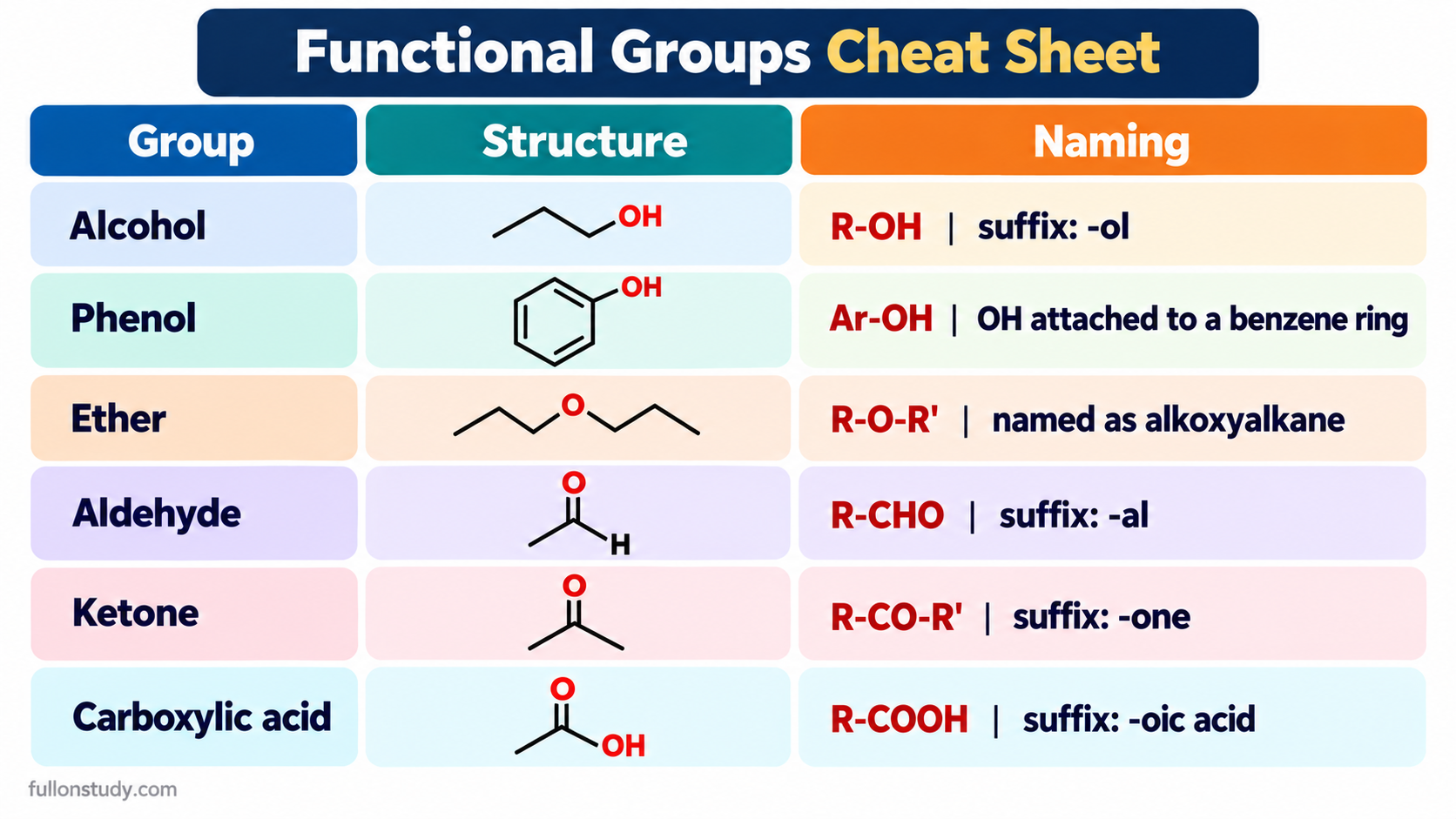
If you know how a functional group behaves, you can predict most products on your own.
The Organic PDF is arranged in these chapters:
- Chapter I: Electromagnetic Spectrum and Absorption Spectra
- Chapter II: Alcohols
- Chapter III: Phenols
- Chapter IV: Ethers and Epoxides
- Chapter V: Aldehydes and Ketones
- Chapter VI: Carboxylic Acids
- Chapter VII: Carboxylic Acid Derivatives
- Chapter VIII: Organic Compounds of Nitrogen
| Unit | Book / PDF Name | Download Link |
|---|---|---|
| 1 | Electromagnetic Spectrum Absorption Spectra | Download |
| 2 | Alcohols | Download |
| 3 | Phenols | Download |
| 4 | Ethers and Epoxides | Download |
| 5 | Aldehydes and Ketones | Download |
| 6 | Carboxylic Acids | Download |
| 7 | Carboxylic Acid Derivatives | Download |
| 8 | Organic Compounds of Nitrogen | Download |
A simple way to revise reactions
Imagine you are revising Aldehydes and Ketones the night before the paper. Reading the whole chapter again feels heavy.
Instead, draw one page per functional group. Write the preparation methods on the left and the reactions on the right.
Then close the notes and redraw the page from memory. The gaps you find are exactly what to revise next.
Physical Chemistry Notes for BSc 2nd Year
Physical Chemistry is where numericals decide your marks.
Understand the idea behind each formula first. Then practice, because speed comes only from solving problems.
The Physical Chemistry PDF covers these chapters:
- Chapter I: Thermodynamics I
- Chapter II: Thermodynamics II
- Chapter III: Chemical Equilibrium
- Chapter IV: Phase Equilibrium
- Chapter V: Electrochemistry I
- Chapter VI: Electrochemistry II
| Unit | Book / PDF Name | Download Link |
|---|---|---|
| 1 | Thermodynamics I | Download |
| 2 | Thermodynamics II | Download |
| 3 | Chemical Equilibrium | Download |
| 4 | Phase Equilibrium | Download |
| 5 | Electrochemistry I | Download |
| 6 | Electrochemistry II | Download |
Thermodynamics: where the chapters connect
Thermodynamics sits behind equilibrium and electrochemistry too, so spend extra time on it.
IUPAC defines Gibbs energy as enthalpy minus the product of thermodynamic temperature and entropy.
That one relation shows up again when you study spontaneity, equilibrium constants and cell reactions.
How to Use These Notes to Score Better
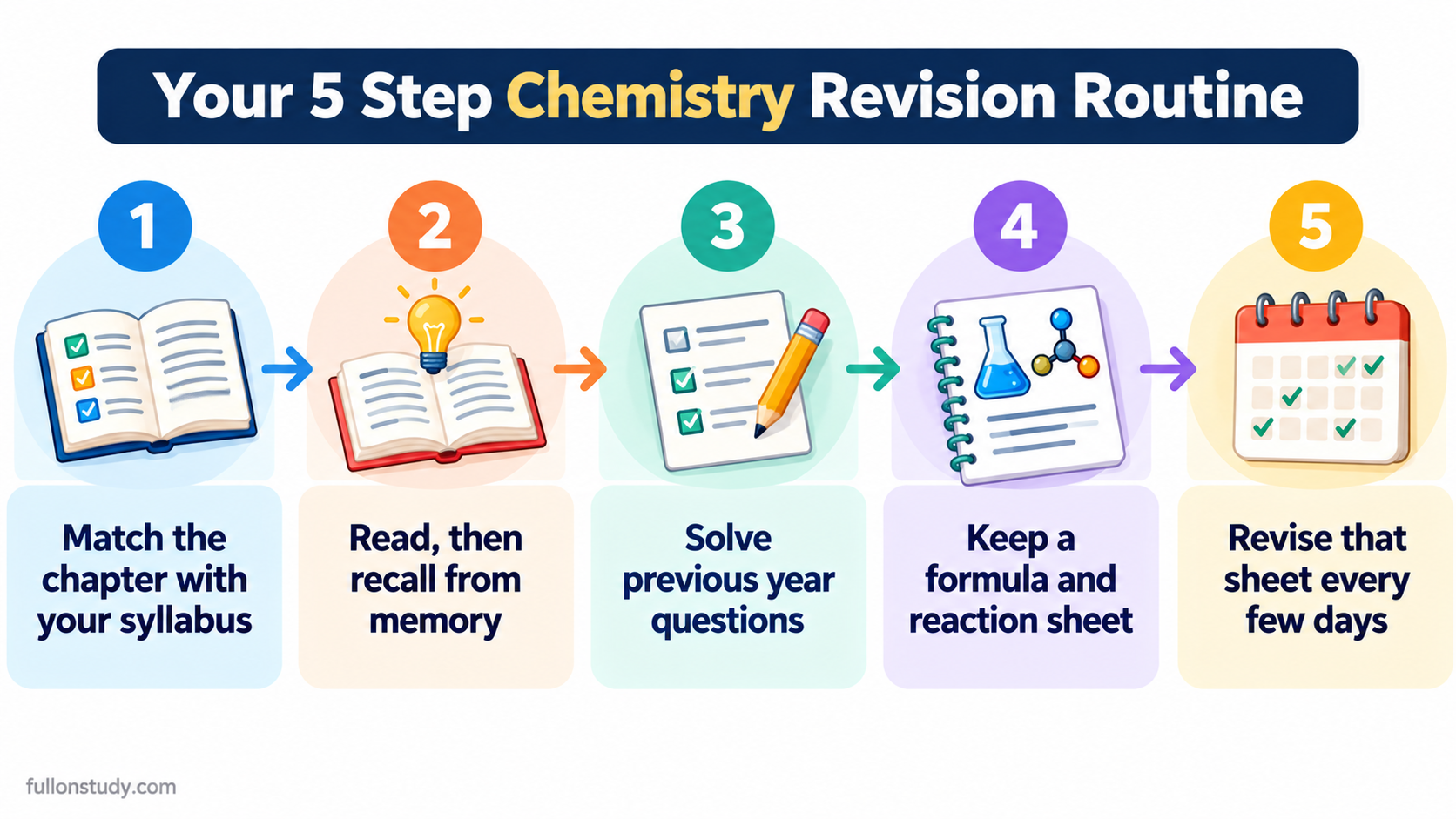
Good notes only help if you use them well. Here is a simple routine you can follow.
- Match each chapter with your university BSc Chemistry syllabus and mark the topics you must cover.
- Read one chapter, then close the PDF and write down what you remember.
- Solve previous year questions for that chapter the same day.
- Keep a short sheet for formulas, definitions and named reactions.
- Revise that sheet every few days, not just before the exam.
Rotate between the three papers during the week. Switching subjects keeps you fresh and stops one paper from being left until the end.
Common Mistakes Students Make in Chemistry Revision
- Reading notes again and again without testing yourself
- Skipping the numericals in Physical Chemistry until the last week
- Memorising reactions without learning the reagent and condition
- Ignoring short chapters like Actinides or Non-aqueous Solvents, which can still bring easy marks
Fix these early and your revision time will count for much more.
Frequently Asked Questions
The notes cover Inorganic Chemistry (transition elements to non-aqueous solvents), Organic Chemistry (spectroscopy to nitrogen compounds) and Physical Chemistry (thermodynamics to electrochemistry). Always compare the chapter list with your own university syllabus.
Use the download button placed under each paper section above. Inorganic, Organic and Physical Chemistry are available as separate PDFs.
They are built for quick revision. For best results, use them with your prescribed textbook and previous year question papers.
Divide your time across all three papers, practice numericals and reactions daily, and test yourself from memory after each chapter.
Not always. Syllabus order and topics differ between universities, so check the chapters you need before you begin.
Start Revising Today
You now have a clear map of the whole year: eight Inorganic chapters, eight Organic chapters and the Physical Chemistry chapters, all in separate PDFs.
Pick one paper, download it and finish a single chapter today.
Looking for more? Browse the other BSc study material on Fullonstudy, or revisit your BSc 1st year chemistry notes if you need to refresh the basics.
Disclaimer: These notes are meant for study and revision. Topics and chapter order can vary by university, so always follow your official syllabus.
About the Author(s):

Fullonstudy Team is a passionate team of educators, content creators, and students, committed to bringing you reliable, up-to-date, and accessible study resources. With a blend of academic knowledge, teaching experience, and a focus on simplifying complex topics, we are here to help guide you through your educational journey.
Other key team members who influence the content you read on our website include those in charge of research, content writing, editing, curriculum design, website development, and user experience. We also collaborate with experts in various academic fields to ensure the accuracy and relevance of our resources.

Manisha Joshi has completed her MSc in Physics from Kumaun University, Nainital. She also holds a BSc in Physics, Chemistry, and Mathematics, giving her a strong multidisciplinary foundation in the sciences. Her academic background and interest in physics enable her to create clear, informative, and student-focused educational content.