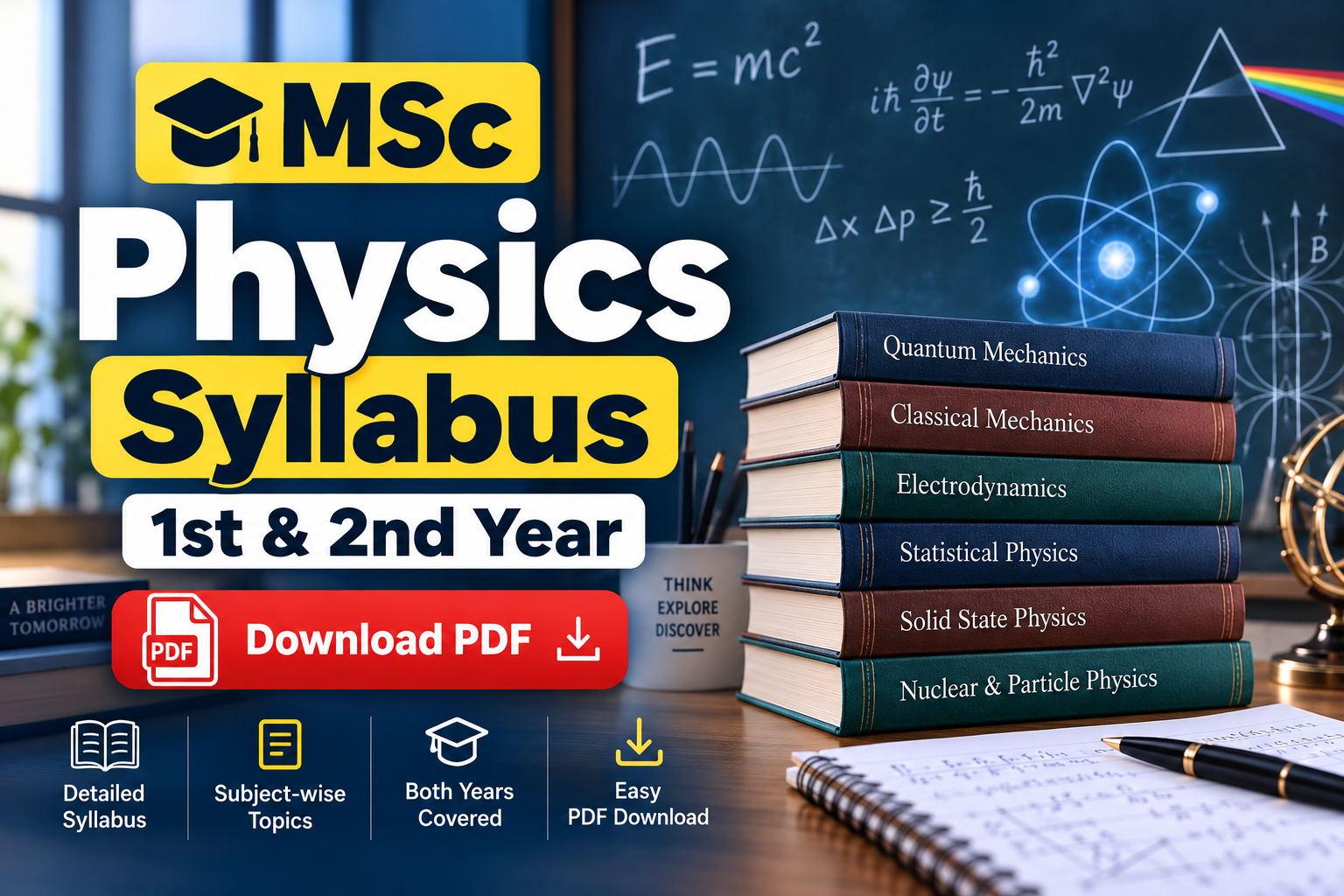
If you are looking for the MSc Physics syllabus – whether for your 1st year, 2nd year, or for a specific government university – this guide covers everything.
We have compiled semester-wise subjects, key topics, popular electives, and at the end, a free download with official syllabus links from over 116 government universities & 60 private universities across India.
If you’re in hurry, jump directly to MSc physics syllabus download links.
About MSc Physics
MSc Physics is a two-year postgraduate programme divided into four semesters.
It is designed for students who have completed a BSc in Physics and want to go deeper into theoretical and experimental physics.
The programme builds advanced skills in quantum mechanics, electrodynamics, statistical mechanics, and condensed matter physics, while also offering research exposure through laboratory work and a final dissertation.
In India, the MSc Physics syllabus at universities follows the Choice Based Credit System (CBCS) recommended by UGC.
Many universities have also updated their syllabus under the National Education Policy (NEP) 2020.
While each university has its own version, the core subjects are largely the same across institutions.
MSc Physics Syllabus 1st Year
The first year of MSc Physics covers the foundational postgraduate-level subjects.
These are theory-heavy semesters that establish the mathematical and physical framework you will use throughout the programme.
Semester I Subjects
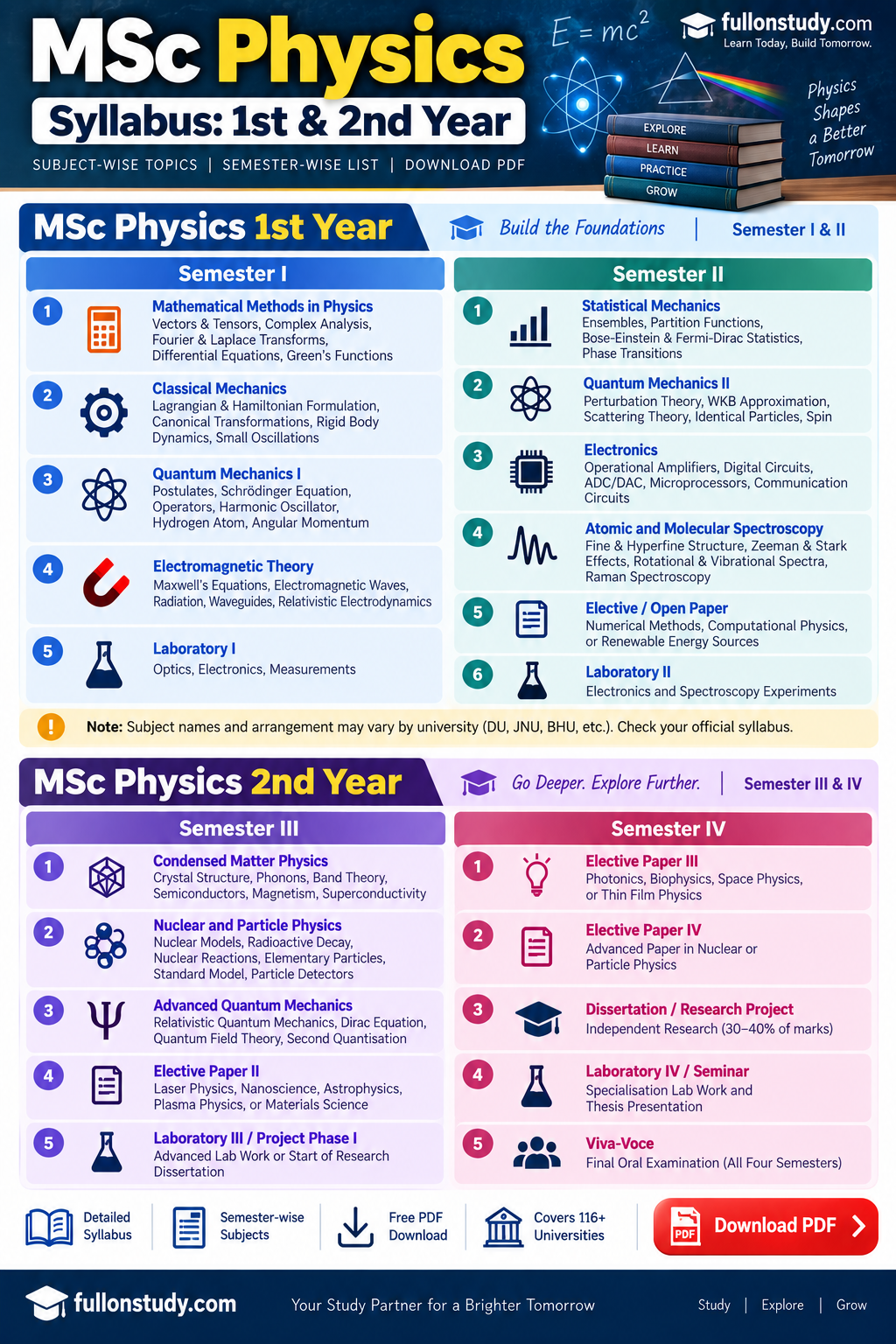
- Mathematical Methods in Physics: Vectors and tensors, complex analysis, Fourier and Laplace transforms, differential equations, Green’s functions, special functions
- Classical Mechanics: Lagrangian and Hamiltonian formulations, canonical transformations, Hamilton-Jacobi theory, rigid body dynamics, small oscillations
- Quantum Mechanics I: Postulates of quantum mechanics, Schrödinger equation, operators and eigenvalues, harmonic oscillator, hydrogen atom, angular momentum
- Electromagnetic Theory: Maxwell’s equations, electromagnetic waves, radiation, waveguides, relativistic electrodynamics
- Laboratory I: General physics experiments covering optics, electronics, and measurements
Semester II Subjects
- Statistical Mechanics: Microcanonical, canonical and grand canonical ensembles, partition functions, Bose-Einstein and Fermi-Dirac statistics, phase transitions
- Quantum Mechanics II: Perturbation theory, WKB approximation, scattering theory, identical particles, spin and addition of angular momenta
- Electronics: Operational amplifiers, digital circuits, ADC/DAC converters, microprocessors and interfacing, communication circuits
- Atomic and Molecular Spectroscopy: Fine and hyperfine structure, Zeeman and Stark effects, rotational and vibrational spectra, Raman spectroscopy
- Elective / Open Paper: Numerical Methods, Computational Physics, or Renewable Energy Sources depending on the university
- Laboratory II: Electronics and spectroscopy laboratory experiments
Note: Some universities like DU, JNU, and BHU arrange these subjects differently or split them across papers. Always check your specific university’s official syllabus – links for all 176+ universities are available in the free download at the bottom of this page.
MSc 2nd Year Physics Syllabus
The second year shifts toward advanced and applied physics.
Students go deeper into nuclear physics, condensed matter, and particle physics, while also choosing their specialisation electives.
The fourth semester typically ends with a research dissertation or project, which carries significant weight in the final result.
Semester III Subjects
- Condensed Matter Physics: Crystal structure, lattice dynamics and phonons, band theory, semiconductors, magnetism, and introduction to superconductivity
- Nuclear and Particle Physics: Nuclear models (liquid drop, shell model), radioactive decay, nuclear reactions, elementary particles, quarks, Standard Model basics, and particle detectors
- Advanced Quantum Mechanics: Relativistic quantum mechanics, Dirac equation, introduction to quantum field theory, second quantisation
- Elective Paper II: Specialisation begins (Laser Physics, Nanoscience, Astrophysics, Plasma Physics, or Materials Science depending on the university)
- Laboratory III / Project Phase I: Advanced laboratory work or beginning of the research dissertation
Semester IV Subjects
- Elective Paper III: Advanced specialisation in areas such as Photonics, Biophysics, Space Physics, or Thin Film Physics
- Elective Paper IV: Open elective or advanced paper in nuclear or particle physics
- Dissertation / Research Project: Independent research under a faculty supervisor. This typically accounts for 30–40% of second year marks
- Laboratory IV / Seminar: Specialisation lab work and thesis presentation
- Viva-Voce: Final oral examination covering all four semesters
Popular Electives and Specialisations
From the second semester onwards, students can choose elective papers based on their interest. The availability of each specialisation depends on the university.
The most commonly offered electives across Indian universities are:
- Laser Physics and Photonics
- Nanoscience and Nanotechnology
- Astrophysics and Cosmology
- Plasma Physics
- Materials Science
- Biophysics
- Computational Physics
- Radiation Physics
- Crystal Growth and Thin Films
- Space Physics and Atmospheric Physics
- Fibre Optics and Sensors
- Quantum Computing (offered at select universities)
If you have a specific specialisation in mind, it is worth checking which universities offer it before applying.
Our free Excel download includes notes on specialisations available at each university.
MSc Physics Syllabus PDF: 116 Govt & 60 Pvt Universities
Finding the official syllabus for your specific university can be difficult – department pages change, PDFs get moved, and search results often lead to outdated or third-party sources. We have done this research for you.
We verified, one by one, every government university in India that offers a standalone MSc Physics programme.
Each entry in our free Excel file has a direct official link – either to the university’s department page or to the actual syllabus PDF hosted on the university’s .ac.in domain.
| University Type | Count | Examples |
|---|---|---|
| Central Universities | 33 | DU, JNU, BHU, Hyderabad, Allahabad, JMI, AMU, Pondicherry, Visva-Bharati, Tezpur |
| State Universities – South | 26 | Madras, BDU, Madurai Kamaraj, Osmania, Andhra, Kerala, Calicut, Mysore, Bangalore |
| State Universities – North & East | 31 | Panjab, Lucknow, Calcutta, Jadavpur, Burdwan, Gorakhpur, Patna, Ranchi, Gauhati |
| State Universities – West | 13 | Pune, Mumbai, Nagpur, Baroda (MSU), Gujarat, Sardar Patel, Saurashtra |
| State Universities – MP, CG & Rajasthan | 13 | Devi Ahilya, Vikram, Barkatullah, Rani Durgavati, Pt. Ravishankar Shukla, Kota |
The file is organised by region, colour-coded by university type (Central vs State), and includes each university’s NIRF 2024 rank where available.
You can filter by state, sort by rank, or simply search for your university by name.
📥 Download Free – MSc Physics Syllabus Links for All 116 Government + 60 Private Universities
One Excel file with direct official syllabus links from every verified university in India that offers MSc Physics. Includes Central Universities, State Universities, NIRF ranks, specialisations available, and notes on admission.
Download Free Excel (176 Universities)Frequently Asked Questions
The core subjects are largely the same because most government universities follow the UGC-CBCS framework. Classical Mechanics, Quantum Mechanics, Electrodynamics, Statistical Mechanics, and Condensed Matter Physics appear in almost every university’s syllabus. What differs is the exact depth of coverage, elective choices, paper titles, and credit distribution. Central universities and higher-ranked institutions tend to have more detailed and research-oriented syllabi.
Download our free Excel file above. It contains direct official links – department pages or PDF files – for 116+ government universities & 60+ private universities, all pointing to the university’s own .ac.in website. Find your university in the list, click the link, and you reach the official syllabus.
The first year focuses on building a strong theoretical base: Mathematical Methods, Classical and Quantum Mechanics, Electromagnetic Theory, Statistical Mechanics, and Electronics.
The second year moves into more advanced territory: Condensed Matter, Nuclear Physics, Advanced Quantum Mechanics, and your chosen specialisation – and ends with a research dissertation.
Based on NIRF 2024 rankings, the top government universities for MSc Physics are JNU (rank 10), BHU (rank 7), University of Delhi (rank 11), Jadavpur University (rank 9), University of Hyderabad (rank 16), Calcutta University (rank 19), and Kerala University (rank 31).
The best choice also depends on the specialisation you want and the research facilities available.
Yes, many universities have revised their syllabus under NEP 2020. Key changes include a stronger research component from the first year, multiple exit options (PG Diploma or MSc), and LOCF integration.
Universities like Pondicherry, Dibrugarh, Central University of Haryana, Bharathidasan, and the University of Delhi have already published NEP-aligned syllabi. Check the download links to see the latest version for your university.
About the Author(s):

Fullonstudy Team is a passionate team of educators, content creators, and students, committed to bringing you reliable, up-to-date, and accessible study resources. With a blend of academic knowledge, teaching experience, and a focus on simplifying complex topics, we are here to help guide you through your educational journey.
Other key team members who influence the content you read on our website include those in charge of research, content writing, editing, curriculum design, website development, and user experience. We also collaborate with experts in various academic fields to ensure the accuracy and relevance of our resources.

Manisha Joshi has completed her MSc in Physics from Kumaun University, Nainital. She also holds a BSc in Physics, Chemistry, and Mathematics, giving her a strong multidisciplinary foundation in the sciences. Her academic background and interest in physics enable her to create clear, informative, and student-focused educational content.