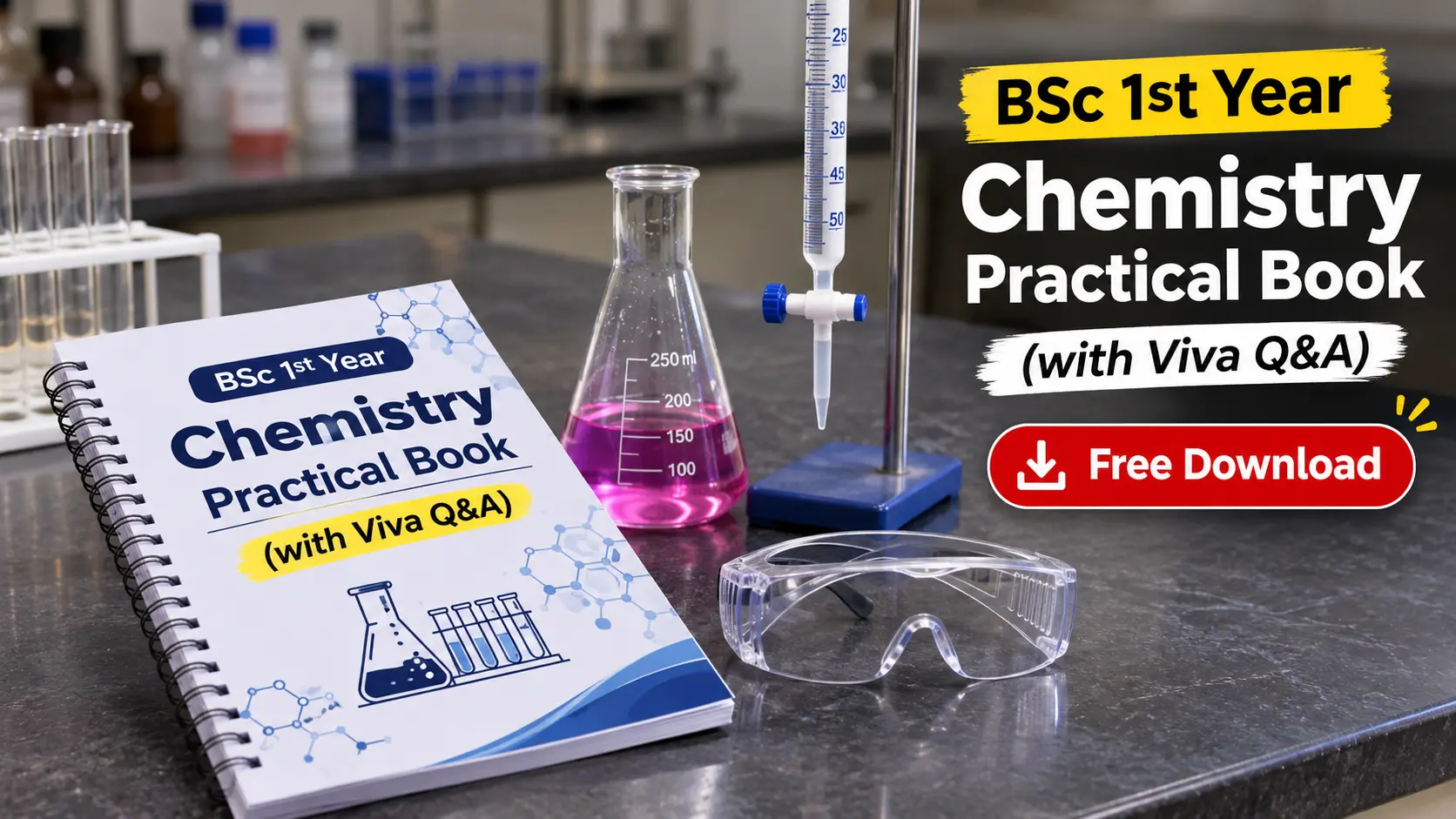
Looking for a reliable Chemistry practical book for BSc 1st Year?
You’re not alone,.. thousands of first-year students search for one every semester, often the night before their practical exams.
In this post, we’ve put together a practical file containing 25+ experiments commonly conducted at Indian universities.
We compiled this list after researching and comparing practical syllabi and files from various universities across India.
We’re confident you’ll find most of your practicals (experiments), along with their solutions, in our free downloadable guide.
If any experiment is missing, you can share it with us on WhatsApp, and we’ll update our practical file accordingly.
If you’re in a hurry, you can jump directly to the download section to get the practical file.
Or, if you’d like to know exactly what’s covered, scroll down to explore the contents before downloading.
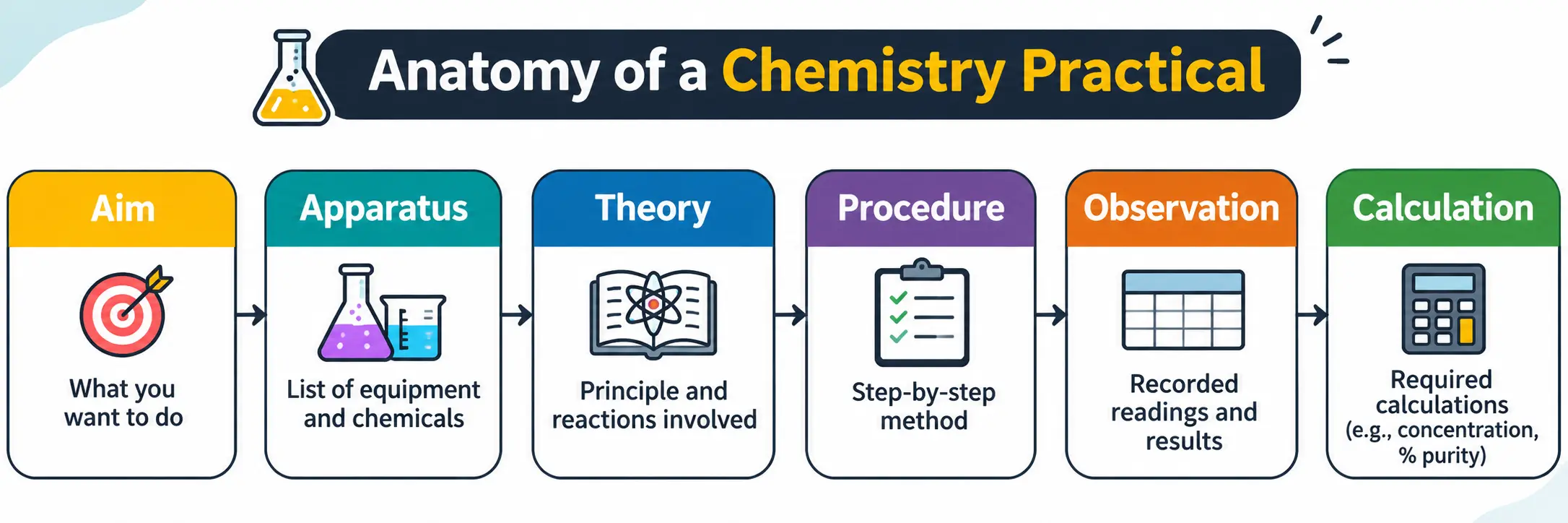
Why Does BSc 1st Year Chemistry Practicals Matter?
Chemistry practicals aren’t just marks on your internal assessment.
They build the lab foundation you’ll need for the rest of your BSc – titrations, qualitative analysis, and organic purification techniques all come back in 2nd and 3rd year in more advanced forms.
Most Indian universities follow the UGC CBCS model curriculum for undergraduate chemistry, which standardises what’s taught across semesters.
You can view the official UGC Learning Outcomes-based Curriculum Framework (LOCF) for Chemistry here: UGC LOCF Chemistry Framework (PDF).
If you want a breakdown of how your overall 1st-year syllabus is structured (not just practicals), check our guide on the BSc 1st Year Chemistry Syllabus.
What’s Covered in the BSc 1st Year Chemistry Practical File?
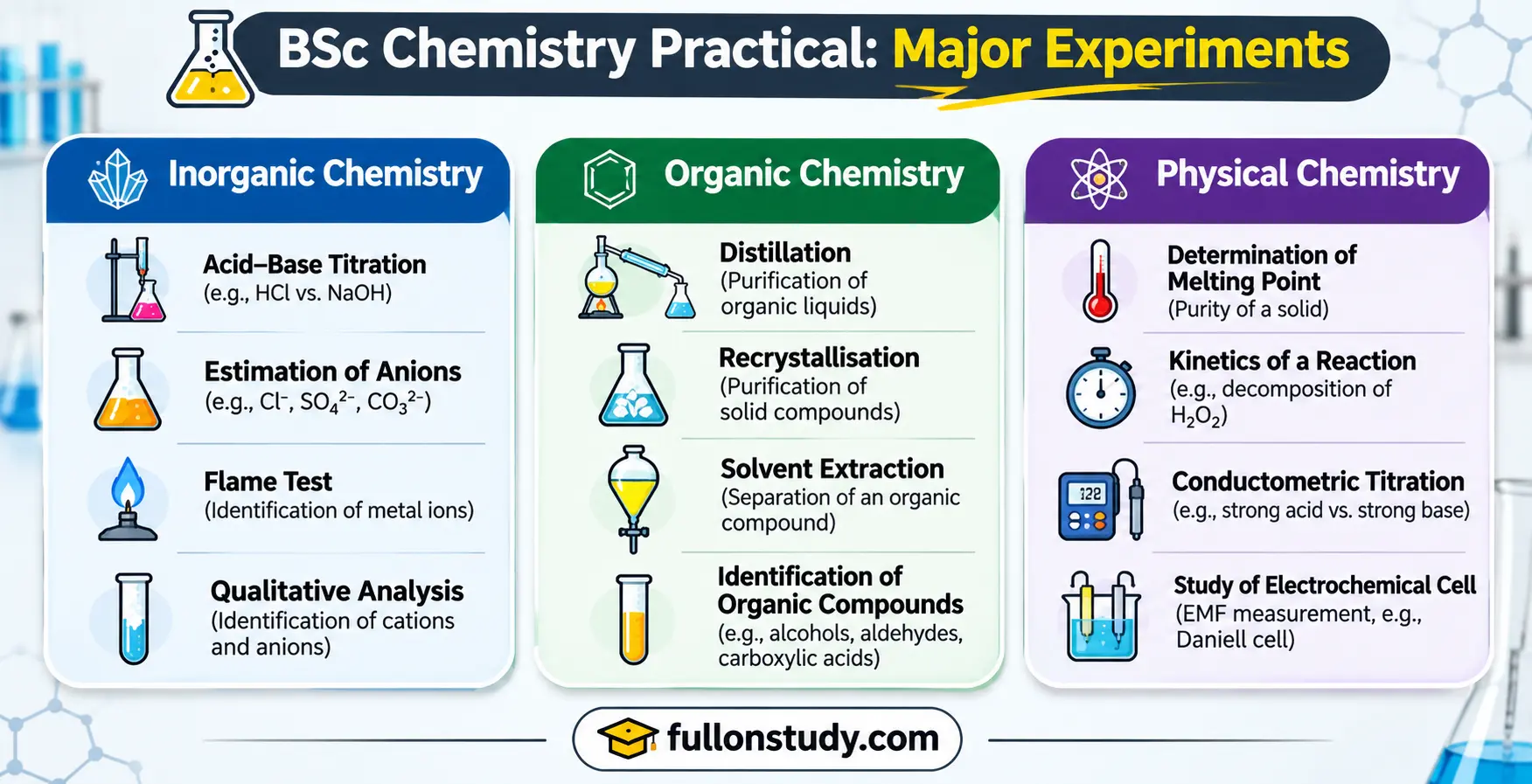
Our chemistry practical book is in English and is splitted into three sections, matching the three branches of chemistry taught in theory: Inorganic, Organic & Physical Chemistry.
Here is the complete list of experiments included in the practical file provided by Fullonstudy:
Volumetric Analysis (Titrimetric) – Inorganic
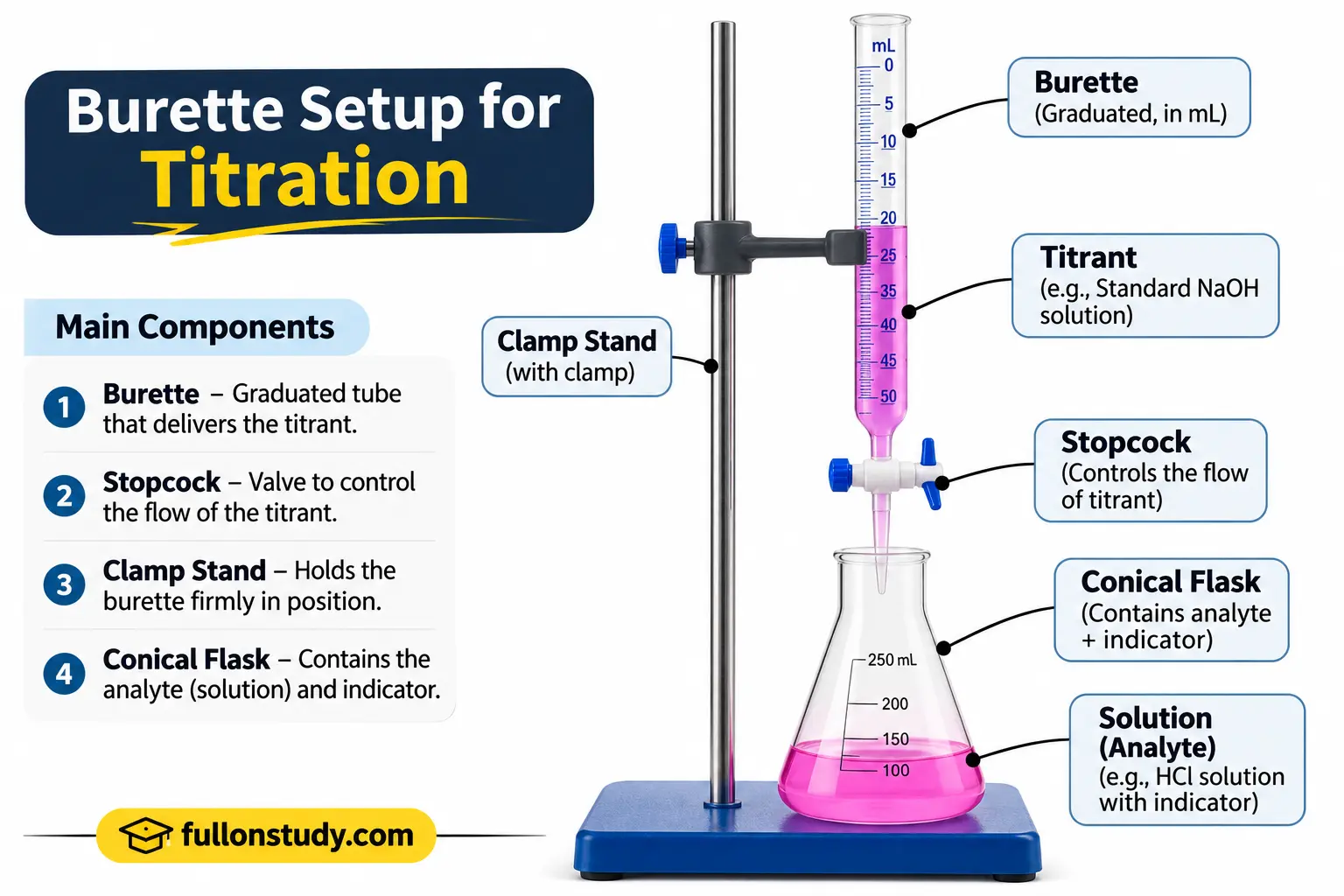
- To estimate the strength of oxalic acid by titrating it against KMnO₄
- To estimate the strength of Mohr’s salt by titrating it against KMnO₄
- To estimate the strength of given CuSO₄ solution iodometrically by titrating it against Na₂S₂O₃
- Estimation of Fe²⁺ by titrating it with K₂Cr₂O₇ using internal indicator diphenylamine
- Estimation of number of water of crystallisation in Mohr’s salt by titrating it with KMnO₄
- Preparation of standard solutions (Normal/Molar solutions)
- Acid-base titration – estimation of Na₂CO₃/NaOH using standard acid
- Estimation of hardness of water (temporary, permanent, total) using EDTA (complexometric titration)
- Estimation of available chlorine in bleaching powder
- Estimation of Ca²⁺ in a given sample using EDTA
Qualitative Inorganic Analysis
- Semimicro qualitative analysis of a simple inorganic salt (identification of acid and basic radicals)
- Analysis of a mixture containing two inorganic salts
Organic Chemistry Practicals
- (a) Recrystallisation of a given sample of organic compound using water as solvent
- (b) Recrystallisation of a given sample of organic compound using alcohol as solvent
- To determine melting point of organic compound using Kjeldahl method & electrical heating apparatus
- To determine boiling point of a given liquid organic compound
- To identify and separate the compounds of a given mixture of two amino acids by ascending paper chromatography & measure Rf value
- Detection of extra elements (N, S, halogens) in organic compounds (Lassaigne’s test)
- Detection of functional groups in organic compounds (carboxylic acid, phenol, aldehyde, ketone, amine)
- Purification of organic compounds by simple distillation
- Purification of organic compounds by steam distillation
Physical Chemistry Practicals
- Determination of viscosity of a liquid using Ostwald’s viscometer
- Determination of surface tension of a liquid using Stalagmometer
- Determination of pH of solutions using pH meter
- Determination of the critical solution temperature (CST) of phenol-water system
[Request to add a new practical/experiment → ]
Download BSc 1st Year Chemistry Practical File (with Viva Questions)
In the chemistry practical book for BSc 1st year students, we have put together a complete collection of chemistry experiments, practical procedures, observation tables, calculations, and viva questions with answers.
This guide will help you understand each experiment, prepare your practical file, revise important concepts, and confidently prepare for your university chemistry practical exams.
| Title | Download Link |
| BSc 1st Year Chemistry Practical File / Book with Viva Q&A (for Inorganic, Organic & Physical Chemistry) – v.1.0 | Download Here |
If you have some practicals that are not covered in this guide, please share the complete list with us on Whatsapp and we will add it in the next version.
Frequently Asked Questions
Where can I download a free PDF of a BSc first-year chemistry practical book?
Check your university’s chemistry department website first, as most publish official practical manuals matching your exact syllabus. You can also use our free, ready-to-use practical file covering 25+ standard experiments.
What are the essential topics for BSc first-year chemistry practicals?
Redox and acid-base titrations, qualitative salt analysis, organic functional group detection, and basic physical chemistry experiments (viscosity, surface tension) are the core topics across most Indian university syllabi.
Which chemistry practical books for BSc first year are available as PDFs?
Publishers like S. Chand, Vishal Publishing, Krishna Prakashan, and R. Chand & Co. offer practical chemistry books; many are also available in PDF format through educational platforms, though you should verify the edition matches your university’s current syllabus.
How do I find a BSc first-year chemistry lab manual based on the Indian university syllabus?
Most universities publish their CBCS/NEP-based practical syllabus as a PDF on their official website. Cross-check this against any practical book or online guide you use.
What experiments are usually covered in a BSc first-year chemistry practical book?
Typically 20-25 experiments across inorganic (titrations, qualitative analysis), organic (recrystallisation, functional group tests, chromatography), and physical chemistry (viscosity, surface tension, pH, conductometry).
Final Words
Chemistry practicals become much easier when you understand what you’re doing instead of just memorizing the steps. We hope this practical book helps you prepare your experiments, revise important concepts, and answer viva questions with confidence.
Keep practising, understand the basics, and don’t stress too much about your practical exams. All the best for your BSc 1st Year Chemistry practicals!
About the Author(s):

Fullonstudy Team is a passionate team of educators, content creators, and students, committed to bringing you reliable, up-to-date, and accessible study resources. With a blend of academic knowledge, teaching experience, and a focus on simplifying complex topics, we are here to help guide you through your educational journey.
Other key team members who influence the content you read on our website include those in charge of research, content writing, editing, curriculum design, website development, and user experience. We also collaborate with experts in various academic fields to ensure the accuracy and relevance of our resources.

Manisha Joshi has completed her MSc in Physics from Kumaun University, Nainital. She also holds a BSc in Physics, Chemistry, and Mathematics, giving her a strong multidisciplinary foundation in the sciences. Her academic background and interest in physics enable her to create clear, informative, and student-focused educational content.